Sankara Eye Hospitals, in partnership with VISION 2020 India, will organise the 20th Annual VISION 2020 India Conference in Bengaluru from July 10 to 12, 2026. The three-day event will bring together ophthalmologists, optometrists, public health specialists, policymakers, researchers, development organisations and healthcare professionals to deliberate on the future of eye care delivery in India.
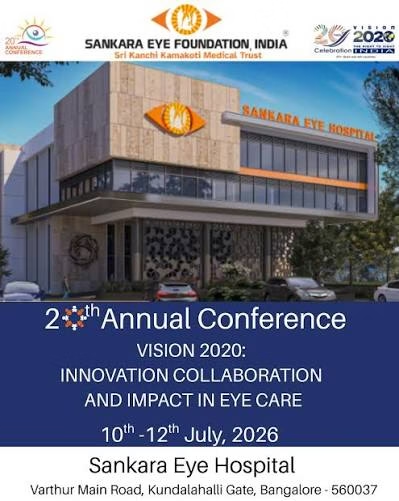
The conference will be held under the theme “Innovation, Collaboration and Impact in Eye Care – Vision for Viksit Bharat 2047.” It aims to provide a platform for exchanging knowledge, showcasing innovations and strengthening collaborations to eliminate avoidable blindness while promoting equitable, accessible and high-quality eye care across the country.
The scientific programme has been structured around five key themes: Innovations and Technological Solutions in Eye Care; Collaboration for Universal Eye Health; Impact, Equity, Sustainability and Quality in Eye Care; Excellence in Optometry and Allied Ophthalmic Personnel; and Sharing Knowledge Repository: Towards Organisational Excellence and Growth.
Sessions will focus on emerging technologies, artificial intelligence, digital health, collaborative models involving government, healthcare providers, NGOs and industry, evidence-based clinical practices, workforce development for allied eye care professionals and knowledge-sharing initiatives among member institutions.
A dedicated leadership session, chaired by Dr Rajesh Saini, President of VISION 2020 India, will feature speakers including Dr R. V. Ramani, Peter Holland and Heidi Chase. Former India cricket captain and 1983 World Cup-winning team member Krishnamachari Srikkanth will deliver a special address titled “Leadership Lessons from Cricket,” highlighting leadership, teamwork, resilience and high-performance principles.
Commenting on the event, Dr Kaushik Murali, President – Medical Administration, Quality & Education, Sankara Eye Foundation India, said the conference reflects a forward-looking approach to eye care. He noted that advancements in artificial intelligence, digital health and innovative service delivery models have the potential to significantly improve access to quality eye care across India. He added that the event will enable clinicians, researchers, policymakers and healthcare leaders to collaborate on scalable solutions supporting universal eye health and the country’s vision of Viksit Bharat 2047.
The conference also coincides with the 50th anniversary of the Sankara movement. Over the past five decades, Sankara Eye Hospitals has expanded eye care access to underserved communities through outreach programmes and service delivery initiatives.
The programme will include keynote lectures, plenary sessions, panel discussions, workshops, paper presentations and interactive sessions covering artificial intelligence, digital health, community ophthalmology, quality improvement, public-private partnerships and capacity building.
Dr Rajesh Saini said the future of eye care will depend on collective efforts rather than individual institutions. He emphasised that achieving the goals of Viksit Bharat 2047 will require an integrated, technology-enabled and patient-centric eye care ecosystem supported by strong partnerships among government, healthcare institutions, academia, civil society, industry and development partners, in line with the principles of SDG 17.
According to the organisers, VISION 2020 India has spent the past two decades bringing together organisations committed to eliminating avoidable blindness through advocacy, research, capacity building and knowledge exchange. The 20th edition of the conference is expected to strengthen these partnerships while contributing to India’s long-term roadmap for universal eye health.
The event is expected to attract delegates from across the country, creating opportunities for scientific collaboration, policy discussions and joint action to improve eye health services nationwide.
Peter Holland, Chief Executive Officer of the International Agency for the Prevention of Blindness (IAPB), said India continues to demonstrate strong leadership in advancing eye health. He highlighted achievements such as the elimination of trachoma, the inclusion of cataract surgery under publicly funded health schemes and the expansion of eye care services ranging from early childhood screening to wider community-based care. According to him, these accomplishments reflect the impact of sustained government commitment and effective cross-sector collaboration.