
In a significant move to strengthen primary healthcare services and promote digital health adoption, the Union Health Ministry has introduced a dedicated mobile application aimed at improving the clinical workflow of Community Health Officers (CHOs) across India.
Developed by the Indian Council of Medical Research, the application functions as a comprehensive clinical decision-support system and job-aid for CHOs working at Sub-Centre Ayushman Arogya Mandirs (SC-AAMs). It aligns with the 12 service packages under Comprehensive Primary Health Care (CPHC), ensuring a structured and standardised approach to patient care.
The app offers guided clinical workflows that act as quick-reference tools for outpatient management. It provides step-by-step assistance in patient evaluation, including history taking, physical examination, and diagnostic recommendations based on symptoms. This helps CHOs efficiently identify cases that require urgent referral to higher-level healthcare facilities.
For critical situations, the platform supports pre-referral stabilisation, while for non-emergency cases, it recommends suitable treatment at SC-AAMs, referral pathways, or teleconsultation with specialists.
Organised into three main sections workflows, assessment tools, and “treat and counsel” the app uses a colour-coded system to simplify decision-making: red for emergencies, orange for specialist consultation, yellow for manageable conditions, and green for mild or routine cases.
Additionally, the application integrates features such as patient registration, electronic health records (EHR), teleconsultation, diagnostic reporting, and follow-up tracking. It is also designed to seamlessly connect with national digital health platforms, ensuring continuity of care.
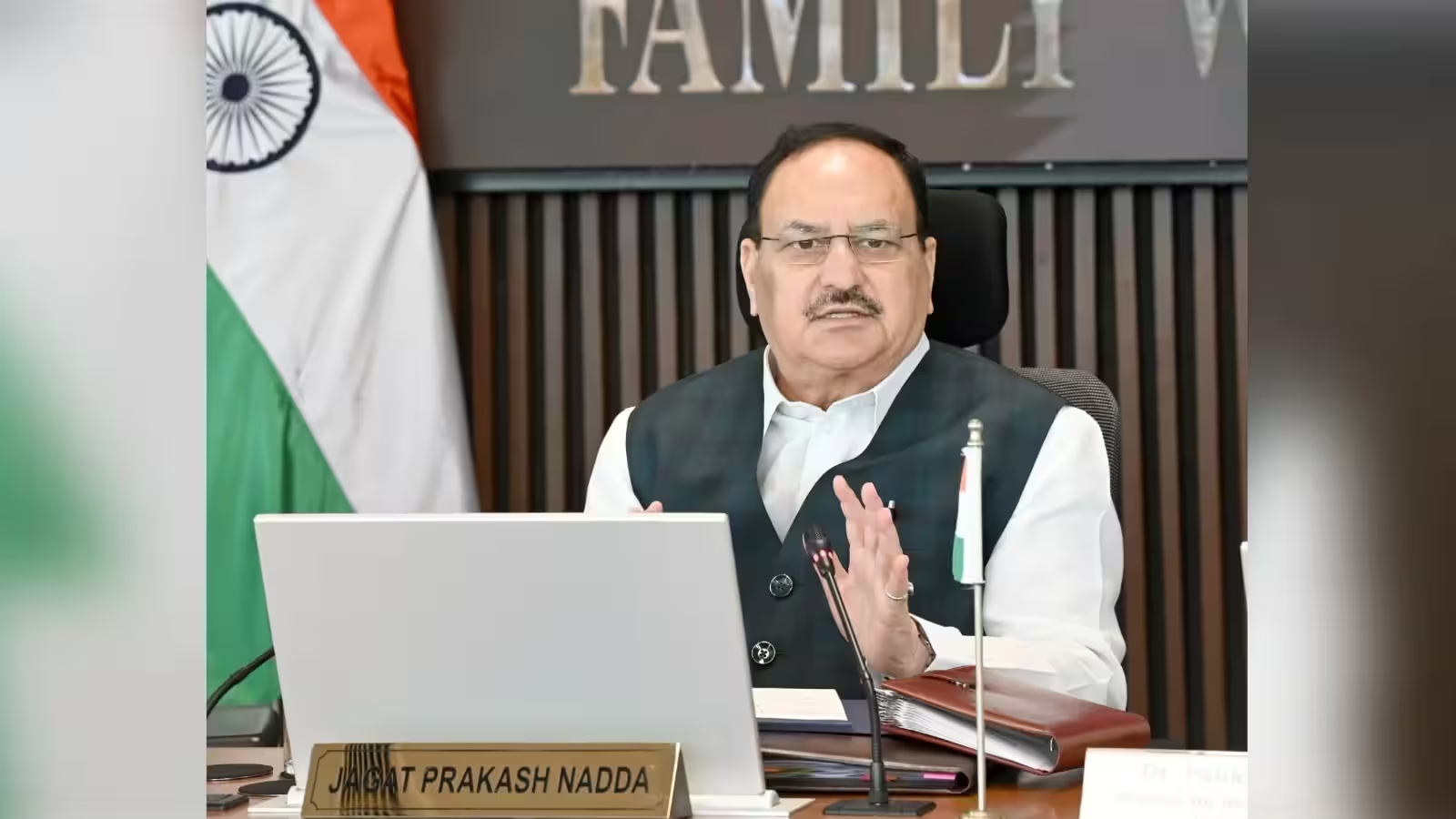
Speaking at the launch, V K Paul highlighted the importance of strong primary healthcare systems in achieving universal health coverage. He noted that the app’s rollout coincides with eight years of the Ayushman Arogya Mandir initiative, marking a key milestone.
Rajiv Bahl described the launch as an important step towards strengthening digital clinical support at the grassroots level. He emphasised that the platform will evolve continuously based on user feedback and field experience.
The initiative is expected to improve the quality, consistency, and timeliness of healthcare services while equipping frontline workers with standardised, evidence-based clinical tools.