


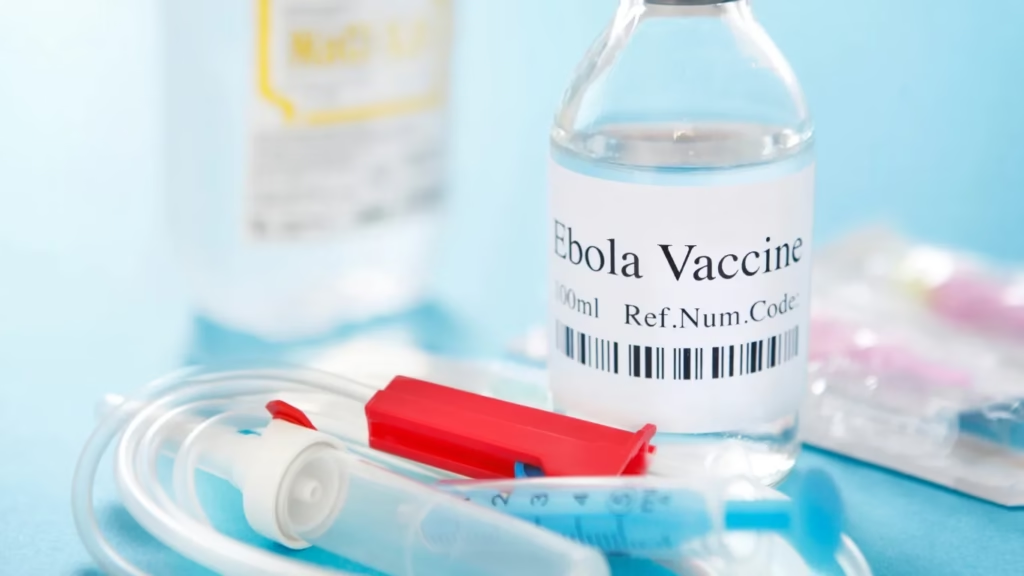
The World Health Organization (WHO) has identified a group of experimental Ebola treatments and vaccine candidates that could soon be tested in clinical trials as health authorities race to contain the rapidly expanding Bundibugyo strain outbreak in the Democratic Republic of the Congo (DRC) and neighboring Uganda. The outbreak has raised global concern because there are currently no approved vaccines or therapies specifically designed for the Bundibugyo strain of Ebola.
The WHO said it has convened expert advisory groups to evaluate potential therapies and vaccines that could be prioritized for urgent clinical testing. The agency stressed that all candidate treatments and vaccines should only be used within carefully monitored clinical trials to ensure safety, efficacy and ethical oversight.
Among the treatments identified for priority evaluation are Mapp Biopharmaceutical’s MBP134 antibody therapy, Regeneron’s maftivimab and Gilead Sciences’ antiviral drug remdesivir. WHO experts also recommended studying combination therapies involving monoclonal antibodies alongside remdesivir to determine whether such approaches could improve survival outcomes for infected patients.
In addition to treatments for infected patients, WHO also highlighted preventive therapies for people exposed to confirmed Ebola cases. One of the most closely watched candidates is Gilead’s oral antiviral obeldesivir which may be tested as a post-exposure preventive treatment among contacts of infected individuals. WHO experts noted, however, that the success of such a strategy would depend heavily on effective contact tracing systems,which remain difficult in conflict-affected regions of eastern Congo.
On the vaccine front, WHO experts identified two promising candidates. The first is the single-dose rVSV Bundibugyo vaccine being developed by the International AIDS Vaccine Initiative (IAVI), although experts estimate it may take another seven to nine months before the vaccine is ready for large-scale efficacy trials. The second candidate, ChAdOx1 Bundibugyo developed by the University of Oxford and the Serum Institute of India could potentially become available for trials within two to three months if additional animal testing data supports further development.
WHO also clarified that Ervebo, currently the world’s only licensed Ebola vaccine is not recommended for widespread use against the Bundibugyo strain outside controlled research settings because evidence regarding cross-protection remains limited and inconclusive.
The outbreak has continued to spread across eastern Congo with cases also reported in Uganda, increasing fears of wider regional transmission. WHO Director-General Tedros Adhanom Ghebreyesus said the organization is scaling up testing capacity and strengthening laboratory networks in affected areas to improve real-time surveillance and rapid case detection.
According to WHO data, the outbreak has already resulted in hundreds of suspected infections and significant fatalities in the DRC’s conflict-affected Ituri province where humanitarian conditions and population displacement are complicating containment efforts. Aid organizations are also stepping in to expand treatment capacity with Samaritan’s Purse planning a 50-bed Ebola treatment unit in northeastern Congo.
Health experts warn that the Bundibugyo strain presents a particularly difficult challenge because it differs from the more common Zaire strain of Ebola for which approved vaccines and treatments already exist. WHO and its scientific partners are now working with authorities in Congo and Uganda to develop ethically supervised clinical trial protocols that could accelerate the evaluation of these experimental therapies while help containing the outbreak.