


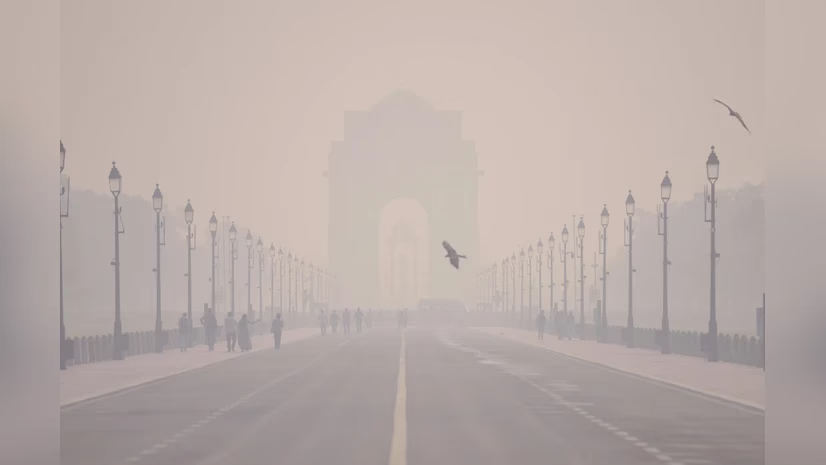
Delhi woke up under another blanket of thick haze on Tuesday (November 25), as the capital’s air quality hovered in the “very poor” category this time amid public worry that ash from a massive volcanic eruption in Ethiopia might worsen conditions.


The concern followed the rare eruption of Hayli Gubbi, a shield volcano in Ethiopia’s Afar region, which spewed a towering ash plume nearly 14 km high on Sunday (November 23). The plume drifted rapidly across the Red Sea and the Arabian Peninsula, eventually making its way toward northwestern India at speeds of 120–130 kmph.
Forecast models from the India Meteorological Department (IMD) indicated that high-altitude ash could briefly influence skies over Gujarat, Rajasthan, Punjab, Haryana and Delhi-NCR on Tuesday. However, the agency stressed that the ash cloud was moving eastward and would clear away from India by 7:30 p.m., heading toward China.
Despite dramatic imagery of the plume’s global journey, meteorologists shared a crucial reassurance: the ash was drifting far above the surface between 25,000 and 45,000 feet and is unlikely to worsen Delhi’s already foul air.
Residents may witness unusual sunrises and sunsets due to the scattering of light by high-altitude ash, experts said, but ground-level pollution is being driven primarily by local and seasonal factors, not the distant eruption.
According to the Central Pollution Control Board (CPCB), Delhi’s AQI stood at 360 on Thursday (November 20), firmly in the “very poor” band, with some stations like Rohini touching “severe” levels at 416. Air quality is expected to remain in the “very poor” range for the coming days.
Delhi also saw a sharp dip in temperatures, with Tuesday’s minimum settling at 9°C over two degrees below average alongside mist and moderate fog.
While volcanic ash contains fine glass-like particles and sulphur dioxide, experts say the risk to Delhi’s surface-level air remains minimal. More immediate concerns include potential aviation disruptions, as high-altitude ash can damage aircraft engines. The DGCA has already issued advisories to airlines flying over affected regions.
Long-term impacts, such as slight changes in night time temperatures or effects on high-altitude ecosystems, cannot be ruled out, but scientists say these would be marginal and slow to unfold.
For now, the consensus is clear: Ethiopia’s volcanic ash made it to Indian skies but Delhi’s toxic air remains overwhelmingly a homegrown problem.