


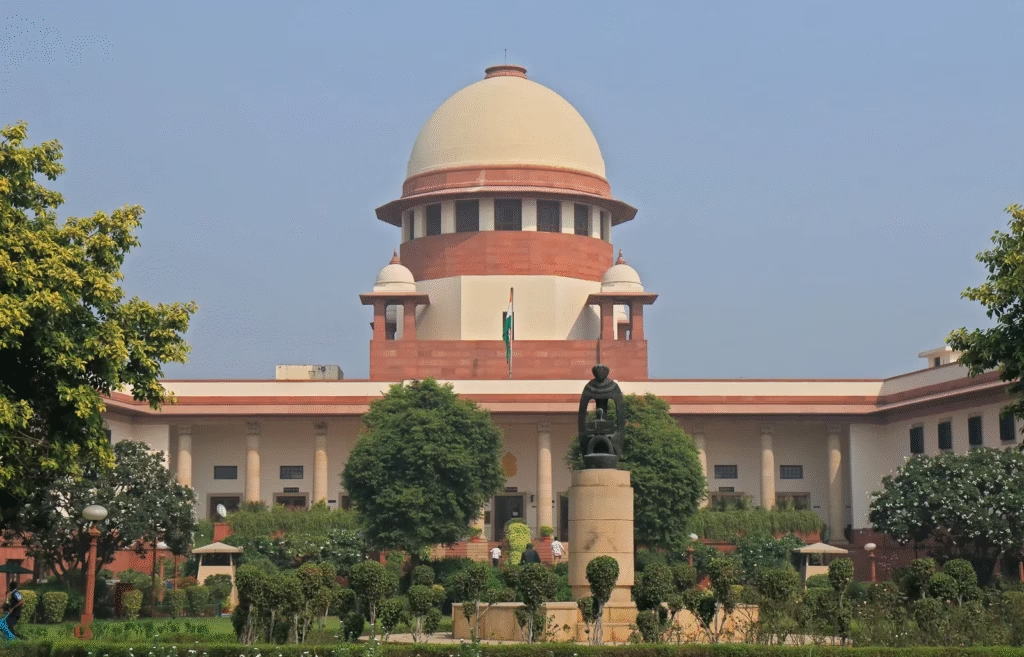
The Supreme Court of India has suggested that state governments consider framing a policy that would allow meritorious postgraduate medical students to defer their mandatory service bonds in order to pursue super-speciality education. The Court observed that such an approach would ultimately benefit states, as doctors would return with advanced skills to strengthen the public healthcare system.
While granting relief in an individual case, the apex court clarified that any deferment of bond service should be accompanied by strict safeguards. These may include written undertakings, financial guarantees and deterrent measures to ensure that doctors return to complete their bond obligations after finishing higher studies.
According to media report, the Supreme Court, on January 28, allowed a doctor to postpone his compulsory bond service and first complete his super-speciality course. The Court directed the Himachal Pradesh government to immediately release his original documents so that he could join the course.
The Division Bench of Justices J.B. Pardiwala and R. Mahadevan noted that the state had insisted the doctor complete the mandatory bond service before applying for a super-speciality programme. However, the Bench pointed out that such a requirement could make highly meritorious candidates ineligible for super-speciality admissions by the time they complete their service.
The case pertained to Dr Chandran, who secured an All India Rank 9 in the DM/MCh super-speciality entrance examination and was selected for counselling at Sree Chitra Tirunal Institute for Medical Sciences & Technology, Thiruvananthapuram. Having already completed his postgraduate degree, he had signed a two-year compulsory service bond with the Himachal Pradesh government, primarily requiring service in rural areas. Since he secured admission to the super-speciality course before commencing bond service, he approached the Supreme Court for relief.
During the hearing, the doctor’s counsel assured the Court that he would return to Himachal Pradesh after completing the three-year super-speciality course and fulfil the two-year bond obligation. The state, on the other hand, argued that service bonds are imposed because postgraduate education is heavily subsidised, including stipends and reduced fees, and is intended to ensure availability of doctors in underserved areas.
Taking these arguments into account, the Supreme Court observed that candidates who execute service bonds may also legitimately aspire to acquire higher qualifications. Requiring them to complete bond service first could, in some cases, deprive them of the opportunity to pursue super-speciality training.
The Bench, therefore, suggested that states consider evolving a mechanism to defer bond service in exceptional cases where candidates secure admission to reputed super-speciality institutions purely on merit. It remarked that such doctors, once trained, would be an asset to the state health system.
In the present case, the Court directed the immediate return of the doctor’s original certificates to enable him to join the course by January 31, 2026. It also ordered him to submit a written undertaking to return and complete the two-year bond service after finishing his studies. The Court warned that any breach of the undertaking would invite contempt proceedings. Additionally, it allowed the state to retain an undated cheque of ₹40 lakh as a financial deterrent, to be returned only after completion of the bond service.
Invoking its powers under Article 142 of the Constitution, the Court granted the relief and left it to the state governments to introspect and consider whether a structured policy could be developed to accommodate exceptional, high-merit cases in the future, as reported by Deccan Chronicle.