


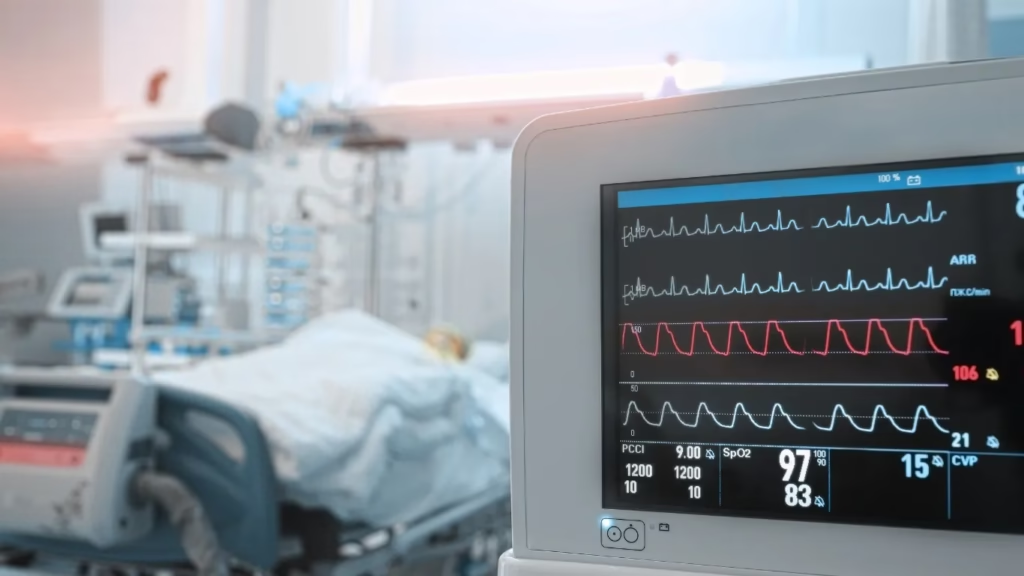
The Supreme Court has approved a nationwide framework to establish minimum standards for Intensive Care Units (ICUs) and critical care services across India in the case Asit Baran Mondal & Anr. vs Dr Rita Sinha & Ors.
A Bench comprising Justices Ahsanuddin Amanullah and R Mahadevan observed that India’s healthcare system is struggling to keep pace with the country’s rapidly growing population, particularly in the area of quality critical care services. The Court stressed the urgent need for better healthcare infrastructure, stating that timely access to ICU care can often determine the difference between life and death.
The Court approved a three-tier ICU system prepared through consultations between States, the Centre and medical experts. It also supported the creation of a nationwide healthcare network featuring GPS-based hospital mapping, tele-ICU integration and standardised emergency care mechanisms.
The Bench directed States to assess gaps in ICU infrastructure within two months and prepare plans to implement minimum ICU standards, beginning with Level-1 ICUs. States were also asked to explore Corporate Social Responsibility (CSR) and NGO funding to strengthen ICU facilities. Additionally, the Court asked States to study the feasibility of maintaining at least five ventilator-equipped ambulances for specialised patient transport.
The Union government was instructed to develop a GPS-enabled nationwide system showing healthcare institutions and available facilities, while also examining ways to connect hospitals for smoother patient transfers and coordination. The Court further suggested standardised public display systems indicating ICU availability at hospitals.
The Bench strongly endorsed telemedicine, tele-ICU and teleconsultation services and urged the Centre to build a nationwide interconnected telemedicine grid.
The Court also raised serious concerns over existing rules allowing nursing colleges to operate even when the affiliated hospital with ICU facilities is located up to 30 kilometres away. Calling the situation “surprising and shocking,” the Bench observed that nursing students dealing with ICU patients require hands-on training in close proximity to hospitals. It indicated that ideally nursing institutions should either be attached to hospitals or located within a one-kilometre radius. The Union government was asked to reconsider the current norms and submit recommendations before the next hearing.
The matter originated from proceedings dating back to 2016 related to alleged medical negligence in private hospitals and the lack of uniform ICU standards nationwide. Even after the original appeal was disposed of in 2024, the Supreme Court continued monitoring the broader issue of standardising ICU infrastructure across the country.
An expert committee comprising Additional Solicitor General Aishwarya Bhati, Amicus Curiae Karan Bharihoke and Dr Nitish Naik was formed to prepare recommendations.
The Court directed all State health departments to submit affidavits detailing compliance measures and action plans before the next hearing scheduled for August 13. Concluding the hearing, the Bench expressed hope that these measures would improve healthcare access for ordinary citizens across the country.