


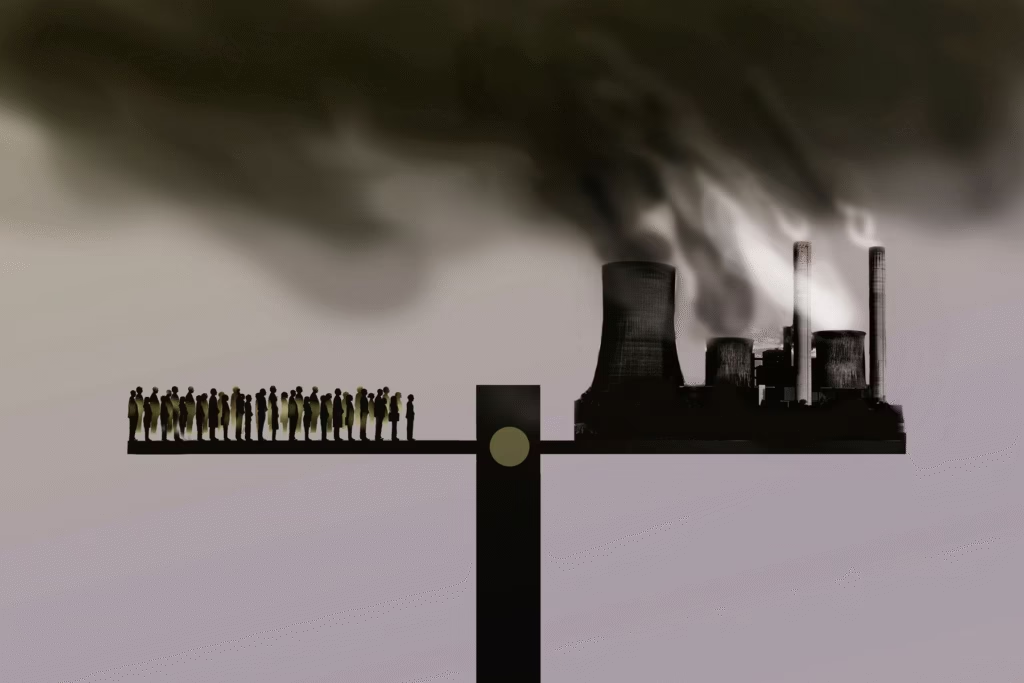
The Supreme Court on Monday (Dec 01) underscored that the air pollution crisis in Delhi-NCR cannot be treated as a seasonal issue taken up only during the winter months, stressing the need for year-round judicial monitoring. A bench headed by Chief Justice Surya Kant and Justice Joymalya Bagchi said the matter will now be listed twice every month to ensure consistent oversight and to push authorities towards both short-term and long-term solutions. The Chief Justice noted that even the day’s Air Quality Index (AQI) showed improvement simply because the matter was being heard, highlighting how accountability often triggers action.
In a significant shift from the typical narrative that blames farmers for Delhi’s pollution every winter, the CJI cautioned against politicising the issue of stubble burning. He questioned why, during the COVID-19 lockdowns, despite stubble burning continuing as usual, residents enjoyed blue skies and clear visibility. This, he said, indicated that multiple other factors were contributing to the pollution crisis. He further emphasised it was unfair to pass the burden onto farmers who are barely represented in court and insisted that the matter should not become an issue of political ego.

The court asked the Centre to outline specific actions taken by agencies like the Commission for Air Quality Management (CAQM) and the Central Pollution Control Board (CPCB). Additional Solicitor General Aishwarya Bhati listed contributors such as vehicular emissions, construction dust, road dust, biomass burning and stubble burning, and assured the court that a comprehensive report detailing measures under each head would be provided. The bench, however, reiterated that all factors must be addressed, not just the commonly cited ones.
Raising concerns over rapid urbanisation and increasing population pressure, the CJI remarked that no Indian city was originally designed to handle today’s population density or the explosion in private vehicle ownership. He pointed out that the uncontrolled growth of cities was adversely affecting the quality of life and demanded realistic strategies rather than measures that exist only on paper.
As India observes National Pollution Control Day 2025, new global data further reinforces the urgent need to address air quality. A report by the Health Effects Institute (HEI) in partnership with UNICEF reveals that air pollution caused 8.1 million deaths worldwide in 2021, making it the second-leading risk factor for death after high blood pressure. Notably, air pollution now kills more people annually than tobacco use and far more than road accidents, which account for about 1.25 million deaths each year. According to the World Health Organization (WHO), broader environmental pollution including air, water, and soil contamination was responsible for 12.6 million deaths in 2012.
The deadly impact of pollution comes largely from microscopic particles such as PM2.5, nitrogen dioxide, sulphur dioxide, carbon monoxide and ozone. These pollutants penetrate deep into the lungs and bloodstream, leading to heart disease, stroke, lung cancer, chronic respiratory conditions and acute infections. Indoor pollution caused by cooking with solid fuels also remains a major contributor to premature deaths. Despite its enormous toll, pollution often receives limited public attention because its effects are slow, invisible and easily misattributed to other diseases.
Experts stress that reducing pollution levels is one of the most effective ways to save lives, calling for cleaner transport systems, a shift to green energy, stricter controls on industrial emissions, improved waste management, access to clean household fuels and sustainable urban planning. The Supreme Court’s move to monitor the issue regularly is being seen as a critical step towards ensuring that air pollution is treated not as an annual crisis but as a continuous public health emergency that demands sustained action.