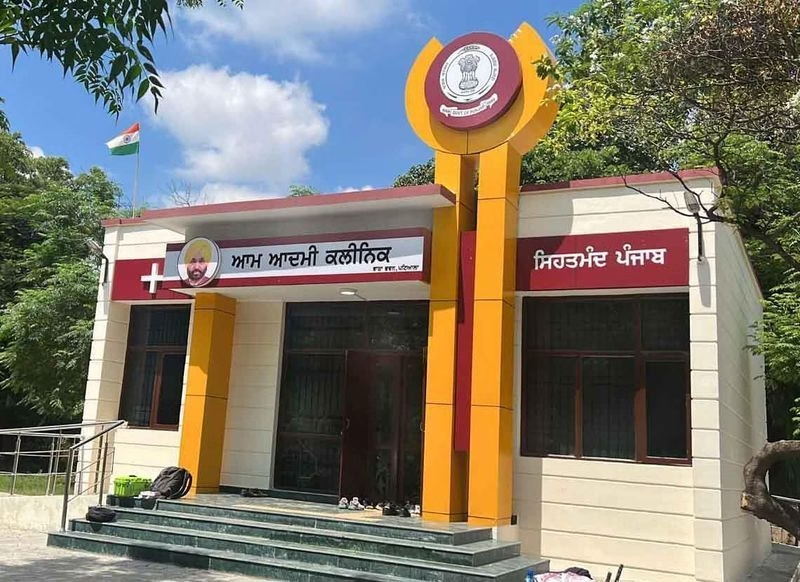
The Punjab government has announced plans to establish Aam Aadmi Clinics (AACs) within the premises of secondary healthcare facilities, including sub-divisional and district hospitals, across the state.
As per a directive issued by the state health department last week, district civil surgeons have been instructed to identify suitable hospital locations for setting up AACs. A key condition is that no existing AAC should be located within a 200-300 metre radius of the proposed sites.
A senior health department official, speaking anonymously, explained that the initiative aims to reduce the patient burden on medical specialists at these facilities. “Several districts have already submitted proposals. The next step is to move the file forward for approval and development,” the official said.
In Patiala, the health department has recommended the Government Mata Kaushalya Hospital as a potential site, which currently handles over 1,400 patients in its daily OPD.
Sources familiar with the matter also noted that the move is likely intended to showcase the Aam Aadmi Party (AAP) government’s flagship healthcare programme by increasing visibility through signage and branding at prominent hospitals.
Recently, however, the AACs have undergone a rebranding process, being renamed as Ayushman Arogya Kendras (AAKs), following a funding dispute with the central government. Funds had been withheld since 2023 due to branding disagreements. In response, the Punjab government agreed to rename 628 of the 881 clinics and removed the image of Chief Minister Bhagwant Mann from their signage.
Healthcare experts have criticized the decision to place AACs within secondary health facilities. They argue that AACs are intended to serve as primary care centres offering basic services such as treatment of common ailments, immunizations, maternal and child healthcare, and health education typically staffed by a general medical officer, pharmacist, and receptionist.
In contrast, sub-divisional and district hospitals are designed for more advanced secondary care and include specialists such as surgeons, gynecologists, and physicians. These hospitals operate around the clock and serve as referral centres for primary health institutions.
Dr. Akhil Sarin, president of the Punjab Civil Services Medical Association, acknowledged that AACs have strengthened primary healthcare by improving lab testing, medication availability, and infrastructure. However, he cautioned that the AAC model is best suited for delivering primary not secondary care services.