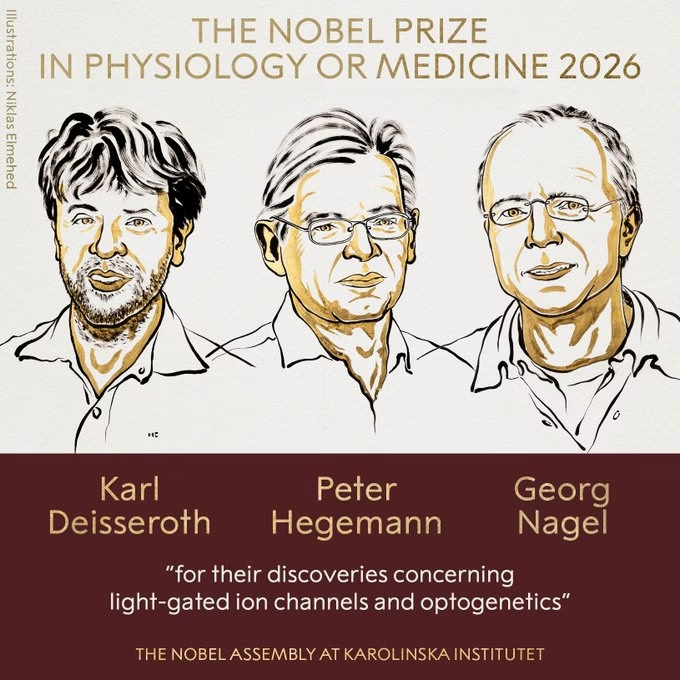
Karl Deisseroth, Georg Nagel and Peter Hegemann recognised for pioneering optogenetics, a technology that lets researchers control specific cells using light.
The 2026 Nobel Prize in Physiology or Medicine has been awarded to Karl Deisseroth, Georg Nagel and Peter Hegemann for discoveries that laid the foundation for optogenetics, a revolutionary technique that enables scientists to control living cells with light.
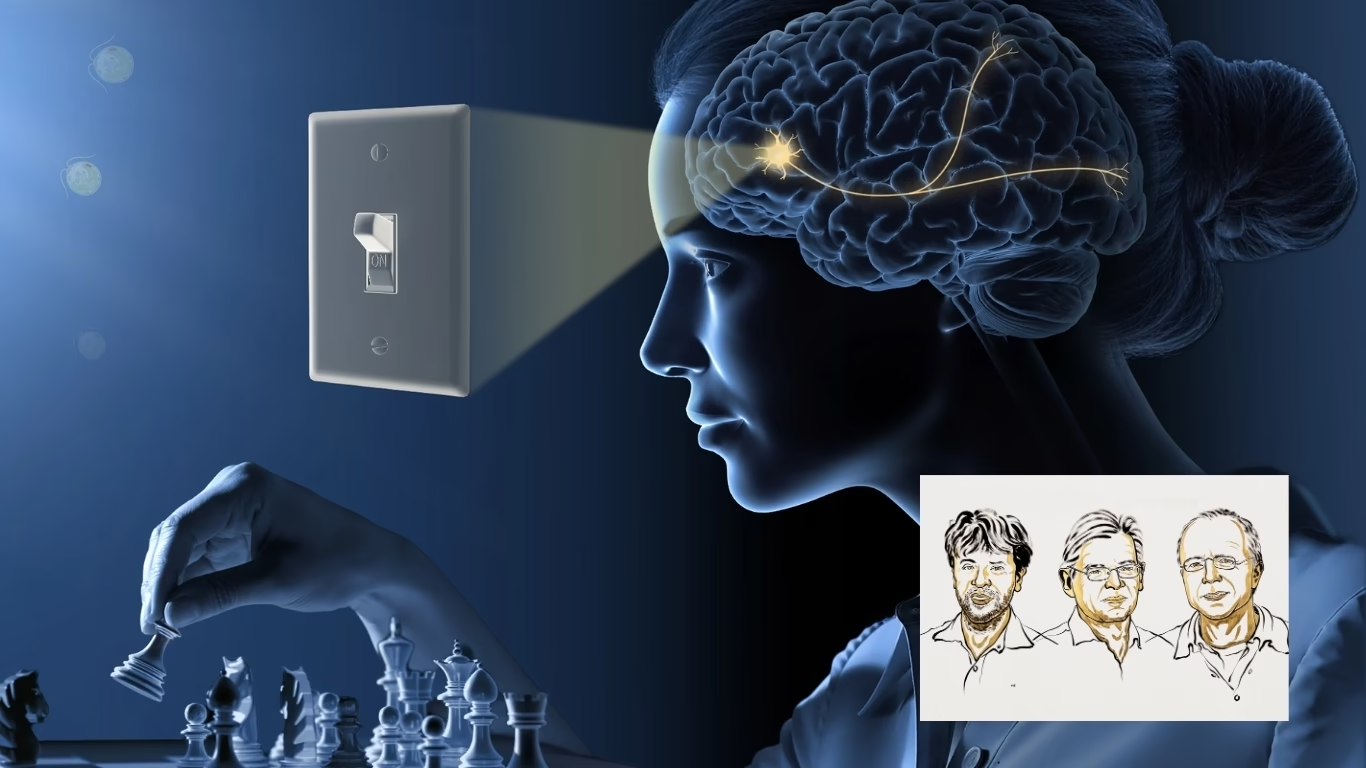
The technology has transformed neuroscience by giving researchers an unprecedented way to study individual neurons and the circuits they form. By combining genetics with light-sensitive proteins known as rhodopsins, scientists can selectively activate or silence particular cells and observe how they influence behaviour and disease.
From a far-fetched idea to a powerful neuroscience tool
The origins of optogenetics can be traced to an idea proposed by molecular biologist Francis Crick, who received the Nobel Prize in 1962. Crick suggested that light could potentially provide a way to control selected cells in the brain without affecting neighbouring cells.
At the time, the concept appeared extremely difficult to achieve. The breakthrough came through research into microorganisms that naturally respond to light.
Hegemann and Nagel studied the green alga Chlamydomonas, which moves towards light. Their research helped establish that rhodopsins light-sensitive proteins embedded in cell membranes play a central role in the organism’s response to light.
These discoveries eventually provided the molecular tools needed to bring Crick’s idea closer to reality.
Deisseroth brings the technology into neuroscience
Deisseroth subsequently helped translate the discoveries about rhodopsins into a method for controlling neurons in mammals.
By introducing genes that produce light-sensitive proteins into selected neurons, researchers can make those neurons respond to particular wavelengths of light. Light delivered through specialised equipment can then trigger or inhibit electrical activity in targeted cells.
This level of precision has changed how scientists investigate the brain.
Rather than simply observing that a particular brain region becomes active during a behaviour, researchers can manipulate specific neurons and ask whether changing their activity actually causes that behaviour.
Revealing the neural circuits behind behaviour
Optogenetics has allowed researchers to investigate how specific groups of neurons contribute to functions including feeding, social interaction, movement and aggression.
The technique has also helped scientists examine neural pathways involved in neurological and psychiatric disorders.
Research using optogenetic approaches has provided insights into conditions including Parkinson’s disease and epilepsy, while studies of disrupted brain circuits have implications for disorders such as depression, addiction and dementia.
The broader significance lies in its ability to establish cause and effect in complex biological systems.
Could optogenetics eventually become a treatment?
Although much of optogenetics remains a research technology, scientists are exploring whether the same principles can eventually be used therapeutically.
One area of investigation is retinitis pigmentosa, an inherited disorder in which light-sensitive cells in the retina progressively die.
Researchers have explored delivering genetic instructions for light-sensitive proteins to surviving retinal neurons. These modified cells can potentially respond to light and transmit electrical signals towards the brain, effectively bypassing damaged photoreceptor cells.
Early clinical research has suggested that this approach could have potential for restoring a degree of visual function in some patients, although optogenetic therapies remain an emerging field rather than an established treatment for most patients.
A new way of understanding the brain
The importance of optogenetics extends beyond the technology itself. The brain contains billions of neurons connected through extraordinarily complex networks, making it difficult to determine precisely how individual cells contribute to thoughts, memories, emotions and behaviour.
Optogenetics provides researchers with a tool to manipulate these networks with far greater precision than many earlier approaches.
Deisseroth has highlighted the possibility of using this precision not only to understand disease mechanisms but also to identify new medicines and neuromodulation strategies.
At the Nobel announcement, Abdel El Manira of the Karolinska Institute said the technology has helped reveal how particular brain circuits function and how they become disrupted in disease, while emphasising that many fundamental questions about the brain remain unanswered.
From algae to potential human therapies
The scientific journey behind the 2026 Nobel Prize illustrates how discoveries in seemingly distant areas of biology can eventually reshape medicine.
Research into how microscopic algae sense light led to the identification of rhodopsins. Those proteins became the foundation for a technique capable of manipulating mammalian neurons. The resulting technology is now being explored not only as a research tool but also for possible therapeutic applications.
The award therefore recognises a chain of discoveries spanning molecular biology, microbiology, genetics and neuroscience.
Laureates and institutions
Karl Deisseroth is a professor at Stanford University. Peter Hegemann is a professor at Humboldt University of Berlin, while Georg Nagel is a professor at Julius Maximilian University of Würzburg in Germany.
The Nobel-recognised work was carried out at institutions including Stanford University, the Max Planck Institute for Biochemistry in Martinsried and the Max Planck Institute for Biophysics in Frankfurt.
A Nobel Prize with implications for the future of medicine
The 2026 medicine prize highlights a shift towards increasingly precise approaches to understanding and manipulating biological systems.
Optogenetics has already changed neuroscience research by allowing scientists to move beyond simply recording brain activity and instead test what happens when precisely defined cells and circuits are switched on or off.
The next stage could be translating that biological precision into therapies for neurological and sensory disorders.
For Deisseroth, the Nobel recognition is not a conclusion to the work. He has indicated that he intends to return to research, with further discoveries and potential ways of helping patients still ahead.
The Nobel Prize in Physiology or Medicine has once again recognised a discovery that began with a fundamental question about how living systems work and could ultimately influence how some of the most complex diseases are treated.