


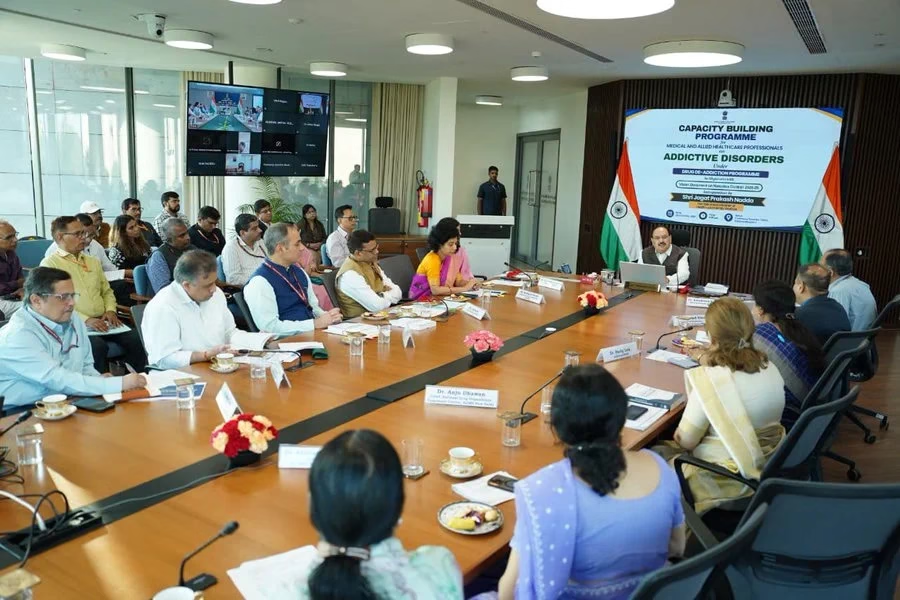
Union Health Minister J P Nadda has called for stronger coordination among government ministries and departments to address substance abuse, emphasising the need for an integrated strategy covering prevention, treatment, rehabilitation and enforcement.
Speaking at the launch of a capacity-building training programme for medical and allied healthcare professionals involved in drug de-addiction services on Oct 26, Nadda said coordinated action and clearly defined responsibilities would be essential to achieving the government’s goal of a Nasha Mukt Bharat by 2029.
The programme was launched in hybrid mode in the presence of senior officials from the Ministries of Health and Family Welfare, Social Justice and Empowerment, and Home Affairs.
Focus on Coordinated Action and Accountability
Nadda highlighted that departments operating independently had resulted in gaps in coordination and service delivery. He referred to the Vision Document on Narcotic Control: 2026–2029, unveiled by Union Home Minister Amit Shah, which outlines specific responsibilities and targets for ministries and departments involved in combating drug abuse.
He emphasised that effective implementation would depend on sustained cooperation between ministries, institutional accountability and coordinated efforts at different administrative levels.
The minister also stressed that addressing substance abuse requires measures beyond medical treatment, including prevention, law enforcement and action against drug trafficking. He called for greater collaboration with enforcement agencies, border-management authorities and other stakeholders.
Training Programme to Strengthen De-Addiction Services
Highlighting the Health Ministry’s responsibilities, Nadda identified professional training, institutional capacity-building and improved treatment services as key priorities.
The newly launched programme includes structured online and offline training for doctors, medical officers, nurses, counsellors and other healthcare professionals engaged in addiction treatment and rehabilitation.
The initiative will follow a phased implementation model, beginning with collaboration between national and regional institutions before expanding training activities across States and Union Territories.
Nadda also called for continued support to de-addiction facilities operating under the Ministry of Social Justice and Empowerment through professional training, institutional development and adequate financial resources.
He encouraged participating healthcare institutions and professionals to provide practical recommendations to address operational challenges and improve coordination between departments.
Emphasis on Youth Health and Prevention
Addressing the gathering, Union Health Secretary Punya Salila Srivastava highlighted the importance of protecting young people from substance abuse as part of India’s broader development objectives.
She said a healthy and productive younger generation would be essential to achieving the vision of Viksit Bharat and stressed the need to strengthen awareness, prevention, treatment and rehabilitation initiatives.
Srivastava also supported an integrated government response involving multiple ministries, departments and institutions to improve the reach and effectiveness of substance abuse prevention and treatment services.
The capacity-building initiative is intended to improve the availability and quality of evidence-based de-addiction treatment while supporting the national objective of a drug-free India by 2029.