


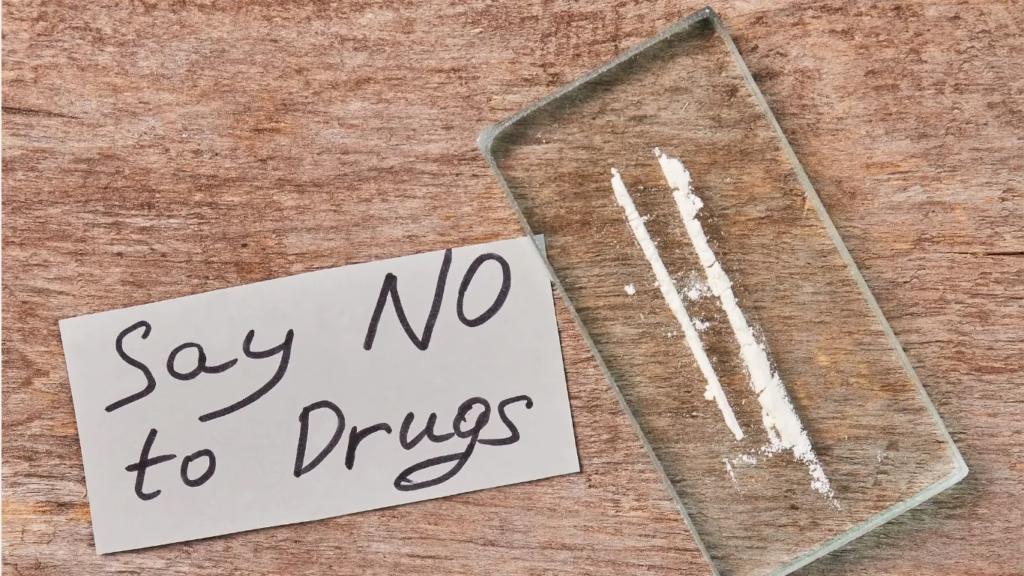
The Maharashtra government has approved an ambitious policy to make the state drug-free by 2029, bringing multiple government departments together for coordinated action against the production, supply and consumption of narcotic substances.
The policy, approved by the state Cabinet, combines strict enforcement with large-scale public awareness, prevention, de-addiction, treatment and rehabilitation. Maharashtra has described the initiative as the country’s first comprehensive state-level campaign based on a “Whole-of-Government Approach.”
Four-Pillar Strategy for a Drug-Free Maharashtra
The policy will operate around four key priorities:
- Stronger enforcement against drug-related activities
- Reduction in the supply of narcotic substances
- Reduction in demand through awareness and prevention
- De-addiction, treatment and rehabilitation of affected individuals
Action will cover the cultivation of crops linked to illegal drugs, as well as their manufacturing, transportation, sale and consumption, including synthetic drugs.
Drug Awareness to Become Part of School Education
Starting from the 2027 academic year, schools will introduce at least one drug-awareness lesson from Class V onwards.
Drug-prevention initiatives will also receive additional points under the Chief Minister’s My School, Beautiful School – Phase 3 programme.
The Higher and Technical Education Department will work towards ensuring that educational institutions maintain drug-free campuses.
Panchayats and Districts to Join the Campaign
The campaign will extend beyond schools and government offices to the grassroots level.
Additional points for drug-prevention efforts will be incorporated into initiatives such as the Chief Minister’s Prosperous Panchayati Raj Campaign and the My Village, Healthy Village Campaign.
The state will also announce a Best Drug-Free District Award every year on June 26, with district performance assessed between October 2 and April 30.
Departments Given Specific Responsibilities
The policy assigns responsibilities across a wide range of departments.
The Home, Transport, Ports, and Law and Judiciary Departments will focus on enforcement, while the Revenue, Agriculture and Forest Departments will work to curb the supply of drugs.
For illegally manufactured synthetic drugs, the Food and Drug Administration and Industries Departments will be responsible for taking action.
Meanwhile, departments including School Education, Higher and Technical Education, Sports, Rural Development, Public Health, Women and Child Development, Skill Development and Entrepreneurship, and Information and Public Relations will focus on reducing demand through awareness and preventive measures.
Focus on De-Addiction and Rehabilitation
The policy also places emphasis on helping people affected by substance use.
The Social Justice and Special Assistance, Public Health, Medical Education, Urban Development, and Skill, Employment, Entrepreneurship and Innovation Departments will work on de-addiction, treatment and rehabilitation.
Nodal Officers to Drive Coordination
To ensure implementation across the government, every department will coordinate with the Anti-Narcotics Task Force (ANTF).
At the Mantralaya level, each department will appoint a Deputy Secretary-rank nodal officer to oversee coordination and implementation.
The move aligns Maharashtra’s strategy with the Centre’s Nasha Mukt Bharat Abhiyan, which aims to support the country’s target of eliminating the drug menace by 2029.
With enforcement, education, community participation and rehabilitation placed under one coordinated framework, Maharashtra is aiming to turn its 2029 drug-free target into a state-wide mission.