


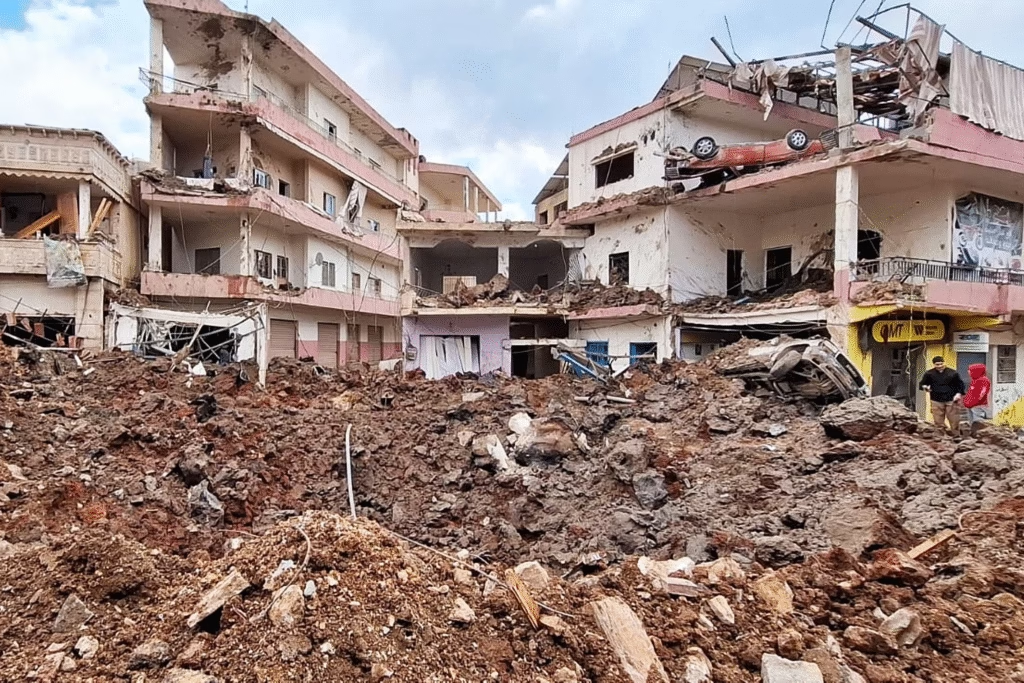
Iran has claimed that at least 25 hospitals have been struck during ongoing US and Israeli airstrikes, raising serious concerns about the country’s healthcare capacity as casualties continue to rise. According to Iranian health authorities, more than 1,200 people have been killed and over 10,000 civilians injured since the attacks began.
Hossein Kermanpour, spokesperson for Iran’s Ministry of Health, said in a post on X that “eight days of war have brought devastation to civilians in Iran.” Among the dead are nearly 200 children under the age of 12 and around 200 women. He also reported that approximately 1,400 women have been injured during the conflict.
The strikes have caused major disruption to Iran’s healthcare infrastructure. Kermanpour said 25 hospitals have been damaged, with nine of them now completely out of service. In addition, 18 pre-hospital emergency bases and 14 ambulances have been destroyed. Two county health centres, 17 comprehensive health service centres and two rural health houses have also been damaged.
The World Health Organization has expressed alarm over the humanitarian consequences of the escalating conflict. WHO Director-General Tedros Adhanom Ghebreyesus said that the violence in Iran and the wider Middle East has killed more than 1,000 people, displaced over 100,000 and affected 16 countries. The agency has verified 13 attacks on healthcare facilities in Iran and one in Lebanon, warning that attacks on medical infrastructure violate international humanitarian law.
Tedros also highlighted wider public health risks, cautioning that potential nuclear-related dangers could pose serious health threats. He noted that operations at the WHO’s Logistics Hub for Global Health Emergencies in Dubai have been temporarily suspended because of security concerns.
Satellite imagery and verified videos reviewed by international monitoring groups indicate that multiple civilian structures, including hospitals, schools and historic landmarks, have been struck since the airstrikes began on February 28. Some medical facilities located near military targets have also been damaged, raising concerns about the risks of conducting attacks in densely populated areas.
Communication with people inside Iran has also become increasingly difficult due to a near-total internet blackout imposed by authorities, limiting access to independent information and verification of events on the ground.
Data compiled by the Human Rights Activists News Agency (HRANA) indicates that at least 752 attacks across 148 separate incidents have been recorded in 30 provinces since the conflict began. As of March 8, HRANA reported at least 1,205 civilian deaths, including 194 children, along with 187 military fatalities and 316 deaths that remain unclassified.
Tehran province has reportedly been the most heavily targeted, accounting for about 34 per cent of all attacks. Other provinces affected include Isfahan, Kermanshah, Khuzestan and Alborz, along with several western regions.
The Iranian Red Crescent Society has also reported extensive damage to civilian infrastructure. Its head, Dr Pir Hossein Kolivand, said nearly 10,000 residential and commercial buildings have been affected. Emergency assessments show that 7,943 residential units and 1,617 commercial properties have been damaged in the strikes.
The attacks have also impacted public facilities, with 32 pharmaceutical and medical centres and 65 schools damaged. Thirteen Red Crescent facilities have also suffered damage.
Emergency response operations have been hit as well. Kolivand said 15 operational vehicles, including 13 ambulances, were damaged, while seven rescue workers were injured in cities such as Tehran, Mahabad and Khomein.
Healthcare workers have not been spared from the violence. According to the Red Crescent, 11 healthcare personnel have been killed and 33 others injured since the conflict began.
In one incident reported by the Hengaw Organization for Human Rights, two emergency medical technicians Hooshang Tork Alia and Sajjad Charkhandeh were killed when an emergency medical services base in Shiraz’s Zibashahr district was struck during airstrikes on March 5.
Medical authorities have also raised concerns about damage to specialised hospital services. Mohammad Raeiszadeh, head of Iran’s Medical Council, said that an in-vitro fertilisation (IVF) department in a hospital was destroyed in one of the attacks. Amin Niakan, deputy for treatment at Shiraz University of Medical Sciences, confirmed that the EMS 115 base building and two ambulances stationed there were completely destroyed.
Calling for the protection of healthcare facilities and workers, the WHO chief stressed that medical infrastructure must not be targeted during conflict. “Attacks on health care violate humanitarian law,” he said, adding that “peace is the best medicine.”