
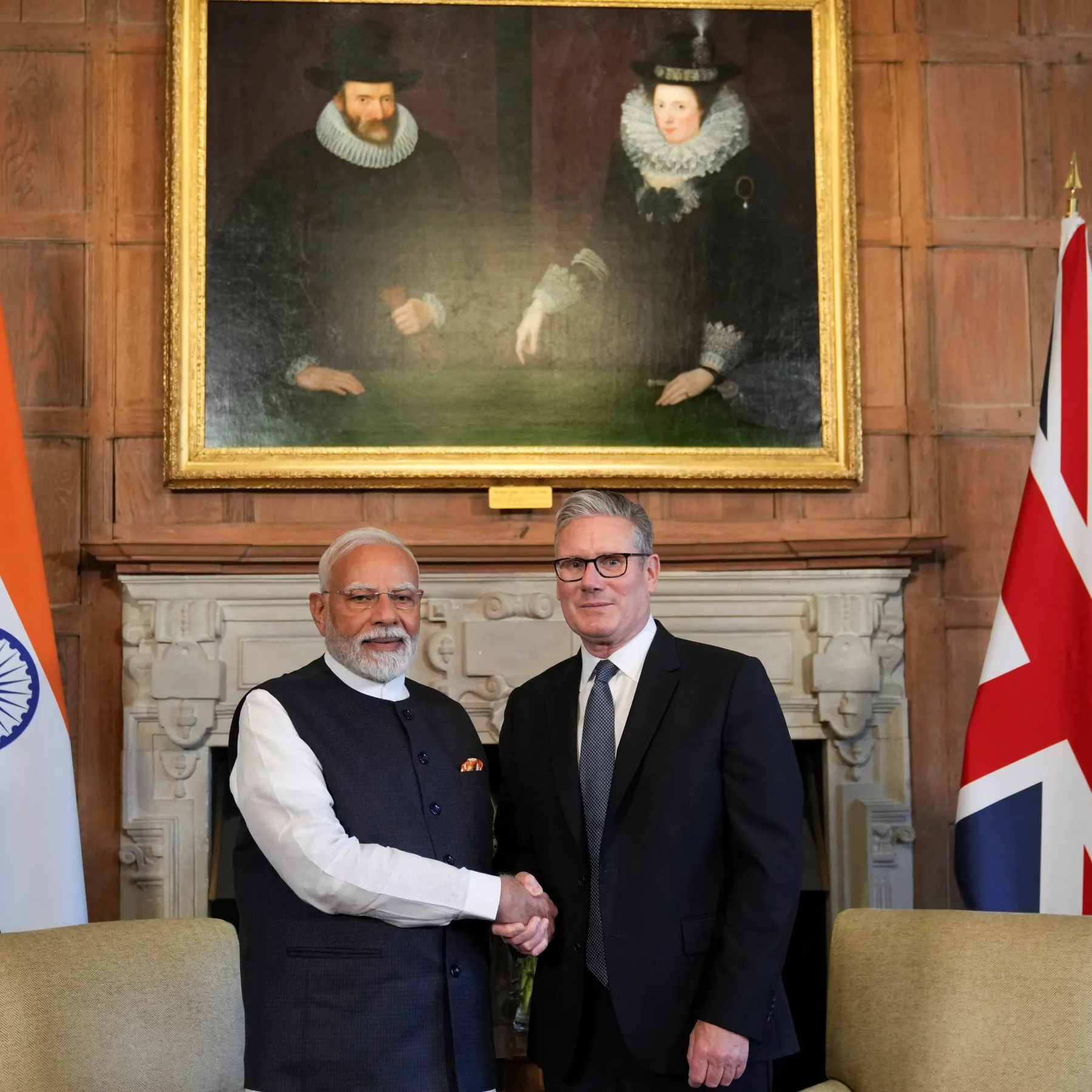
India and the United Kingdom have confirmed that their landmark Free Trade Agreement (FTA) will come into force on July 15, following discussions between Prime Minister Narendra Modi and UK Prime Minister Keir Starmer during the ongoing G7 Summit in Evian-les-Bains, France.
The announcement follows months of negotiations and comes after a widely discussed “hot mic” moment between the two leaders, during which they were overheard saying, “We did it,” fuelling speculation that the final hurdles had been cleared.
One of the major sticking points had been concerns over the UK’s proposed safeguard measures on steel imports. Addressing these concerns, the Indian government clarified that 85 per cent of India’s steel exports to Britain would remain outside the scope of the UK’s safeguard regime, which is scheduled to take effect from July 1, 2026. India said its interests were protected through country-specific quotas, residual allocations and access under the Authorised Use Scheme.
The implementation of the Comprehensive Economic and Trade Agreement (CETA), originally signed on July 24, 2025, marks a significant milestone in India-UK relations and is expected to substantially enhance bilateral trade and investment.
Prime Minister Narendra Modi described the development as a historic achievement. In a post on X, he said the agreement would create fresh opportunities for farmers, workers, MSMEs, startups and innovators, while supporting India’s vision of becoming a developed nation by 2047.
Commerce and Industry Minister Piyush Goyal said the next-generation agreement would provide Indian exporters with a level playing field in sectors such as textiles, leather, marine products, engineering goods and processed foods. He added that the pact would enable India to leverage its manufacturing strength, service capabilities and grassroots enterprises in one of the world’s leading consumer markets.
The UK government, in a statement issued on June 17, said businesses have 28 days to prepare before the agreement takes effect. Companies seeking to benefit from lower tariffs will need to register with HM Revenue and Customs (HMRC). British authorities urged businesses to complete the necessary formalities to fully utilise the opportunities offered by the deal.
According to UK estimates, the agreement could increase Britain’s GDP by £4.8 billion, raise real wages by £2.2 billion and boost annual bilateral trade by £25.5 billion over the long term.
India’s exports to the UK rose 12.4 per cent year-on-year to USD 2.4 billion during the first two months of FY27. This recovery follows a difficult FY26, when exports to Britain fell 7.6 per cent to USD 13.44 billion, while imports from the UK jumped 36.1 per cent to USD 11.7 billion.
The UK agreement is India’s sixth major trade pact since 2021, following similar deals with Mauritius, the UAE, Australia, EFTA and Oman.
India’s major exports to the UK include gems and jewellery, engineering products, petroleum goods, pharmaceuticals, textiles and electronics. Imports from Britain largely comprise precious metals, machinery, electrical equipment, aerospace products, chemicals, medical devices and Scotch whisky.
Key Benefits Under the Agreement
The trade pact grants zero-duty access to a wide range of Indian products entering the UK market, including electronics, textiles, chemicals, pharmaceuticals, toys, gems and jewellery.
Tariffs in labour-intensive sectors have been eliminated, including duties of up to 20 per cent on marine products, 12 per cent on textiles and apparel, 8 per cent on chemicals and 10 per cent on base metals.
Duties of up to 70 per cent on processed food items, 21.5 per cent on marine products, 18 per cent on engineering goods and auto components, and 16 per cent on leather and footwear will also be reduced to zero. The move is expected to generate more than USD 900 million in additional leather and footwear exports.
India said the duty-free access would improve the competitiveness of its products in the UK, create new opportunities for farmers, fishermen, workers, manufacturers and MSMEs, and strengthen the country’s participation in global value chains.
Britain has also removed tariffs on Indian tea, instant coffee and spices. Zero-duty access for electronics is expected to encourage exports of smartphones, optical fibre cables and inverters.
In the food-processing sector, tariffs have been eliminated on 99.7 per cent of product categories, from rates that previously reached as high as 70 per cent. Agricultural exports such as fresh grapes, bakery products, nuts and sauces are also expected to gain from the agreement.
India aims to double bilateral trade with the UK by 2030 from the current level of around USD 56 billion.
From the UK side, average Indian tariffs on British goods will decline from 15 per cent to 3 per cent. Britain expects its exports to India to grow by nearly 60 per cent in the long run, adding an estimated £15.7 billion by 2040.
The agreement is projected to increase bilateral trade by almost 39 per cent over the long term, translating into an additional £25.5 billion annually compared with estimates without the pact.
India will remove duties of up to 11 per cent on aerospace products, while tariffs on electrical machinery, currently as high as 22 per cent, will either be reduced or eliminated.
Tariffs on medical devices, which currently range between 8.25 per cent and 13.75 per cent, will be either abolished or reduced by half over the next decade.
Scotch whisky producers will benefit from an immediate tariff cut from 150 per cent to 75 per cent, with duties falling further to 40 per cent within 10 years. Automobile tariffs, currently at 110 per cent, will gradually decline to 10 per cent under a quota-based mechanism.
The Indian government said the agreement provides duty-free access for approximately 99 per cent of India’s exports to the UK, covering nearly the entire value of bilateral merchandise trade.
At the same time, India has protected sensitive sectors such as dairy products, cereals, millets, edible oils, oilseeds, apples and several vegetable products by excluding them from market-access commitments.
The UK has also offered India one of its most comprehensive services commitments, covering 137 sub-sectors across information technology, financial services, healthcare, education, engineering and consultancy services.
The agreement creates annual mobility opportunities for 1,800 Indian chefs, yoga instructors and classical musicians to work in the UK.
Additionally, the UK-India Double Contributions Convention, which will be implemented alongside the FTA, allows professionals temporarily working abroad to continue contributing to their home country’s social security system without making duplicate payments.
Under the arrangement, British nationals working in India can continue contributing towards the UK’s State Pension for up to 60 months instead of the previous 36 months, while being exempt from Indian social security contributions. The same benefit will apply to eligible Indian professionals working in the UK through existing visa routes.
The Indian government estimates that more than 75,000 Indian professionals and over 900 companies will benefit from the social security arrangement.