
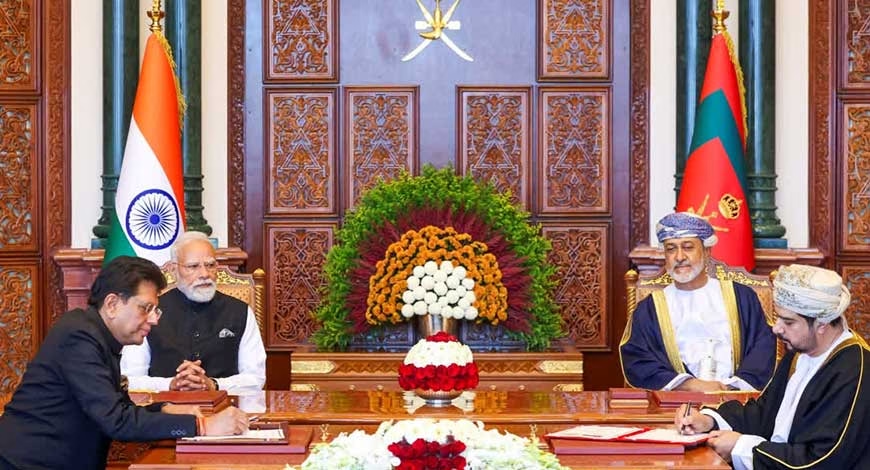
India and Oman have strengthened their economic ties with the signing of a Comprehensive Economic Partnership Agreement (CEPA), marking a major step in bilateral trade relations. The agreement was signed by Commerce and Industry Minister Piyush Goyal and Oman’s Minister of Commerce, Industry and Investment Promotion, H.E. Qais bin Mohammed Al Yousef, under the leadership of Prime Minister Narendra Modi.
The CEPA represents a key milestone in India’s engagement with the Gulf region and underscores the shared intent of both nations to deepen economic integration. Oman is a strategic partner for India and serves as an important gateway for Indian goods and services to the broader Middle East and African markets. Around seven lakh Indians live in Oman, including merchant families with a presence spanning over two to three centuries, playing a significant role in the country’s economy and society. More than 6,000 Indian-owned businesses operate in Oman across various sectors, while annual remittances of about USD 2 billion highlight the depth of economic ties. Bilateral trade between the two countries currently exceeds USD 10 billion and is expected to grow further under the CEPA.
This is India’s second free trade agreement signed in the past six months, following the pact with the United Kingdom. It aligns with India’s strategy of partnering with developed economies that complement, rather than compete with, its labour-intensive sectors, while creating new opportunities for Indian businesses.
Under the agreement, Oman has granted India extensive tariff concessions, offering zero-duty access on 98.08 per cent of its tariff lines, covering 99.38 per cent of India’s exports to Oman. Key labour-intensive sectors including gems and jewellery, textiles, leather, footwear, sports goods, plastics, furniture, agricultural products, engineering goods, pharmaceuticals, medical devices and automobiles will benefit from full tariff elimination. Of these, 97.96 per cent of tariff lines will see immediate duty removal.
India, in turn, has agreed to reduce tariffs on 77.79 per cent of its total tariff lines, covering 94.81 per cent of imports from Oman by value. For Omani products that are of export interest but sensitive for India, tariff liberalisation will largely be implemented through tariff-rate quotas.
To protect domestic interests, India has excluded certain sensitive items from concessions, particularly agricultural products such as dairy, tea, coffee, rubber and tobacco, as well as gold and silver bullion, jewellery, select labour-intensive goods like footwear and sports items, and scrap of several base metals.
The services sector one of the main pillars of India’s economy is also set to gain significantly. Oman’s global services imports stand at USD 12.52 billion, with India currently accounting for just over 5 per cent, indicating considerable scope for expansion. The agreement includes comprehensive commitments across sectors such as computer-related services, business and professional services, audio-visual services, research and development, education, and healthcare. These measures are expected to create new opportunities for Indian service providers, generate skilled employment and strengthen commercial engagement.
A notable feature of the CEPA is the improved mobility framework for Indian professionals. For the first time, Oman has made extensive commitments under Mode 4, increasing the quota for intra-corporate transferees from 20 per cent to 50 per cent. The permitted stay for contractual service suppliers has also been extended from 90 days to two years, with the option of a further two-year extension. The agreement provides more flexible entry and residence conditions for skilled professionals in fields such as accountancy, taxation, architecture, and medical and allied services.
The pact also allows 100 per cent foreign direct investment by Indian companies in major services sectors in Oman through commercial presence, creating significant expansion opportunities. Additionally, both countries have agreed to hold discussions on social security coordination once Oman’s contributory social security system is in place, reflecting a forward-looking approach to labour mobility and worker protection.
Another landmark provision is Oman’s commitment on traditional medicine across all modes of supply the first such comprehensive commitment by any country opening new avenues for India’s AYUSH and wellness sectors in the Gulf region.
The agreement also includes provisions to address non-tariff barriers that can restrict market access despite tariff reductions.
This is the first bilateral trade agreement Oman has signed since its pact with the United States in 2006.
Commerce and Industry Minister Piyush Goyal thanked Prime Minister Narendra Modi for his leadership, stating that the India Oman CEPA builds on the historically strong relationship between the two nations and establishes a balanced and ambitious economic framework. He noted that it provides near-universal duty-free access for Indian goods, expands services commitments in high-growth sectors, enhances professional mobility, and supports inclusive growth while protecting national interests.
Overall, the CEPA is expected to significantly increase bilateral trade, boost exports, create jobs, strengthen supply chains and pave the way for deeper and sustained economic cooperation between India and Oman.