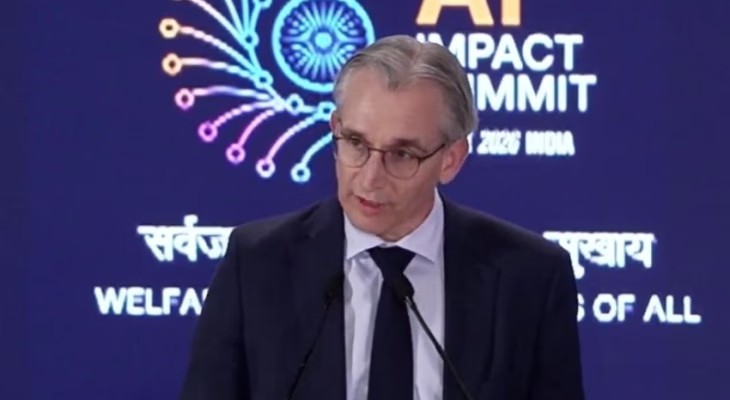
India’s growing role as a global innovation hub, particularly in artificial intelligence-driven healthcare solutions, could significantly transform healthcare delivery models worldwide, according to Roy Jakobs, CEO of Royal Philips.
Speaking at the AI India Summit, Jakobs said AI is poised to make its most profound impact in healthcare a sector where India presents a unique opportunity due to its strong talent base, expanding digital infrastructure and ambitious reform agenda.
He highlighted that India’s digital public health initiatives, including Ayushman Bharat and the Ayushman Bharat Digital Mission, are creating the groundwork for interoperable health records and long-term patient data systems. Such structured, large-scale datasets enable continuity of care for vast populations and open the door to advanced data-driven healthcare models.
According to Jakobs, healthcare is transitioning from a reactive approach to a predictive one, from fragmented systems to integrated networks, and from episodic treatment to continuous care. The digital and AI-enabled systems being developed today, he noted, will influence the health outcomes of billions in the future.
He emphasised that AI thrives on structured, high-quality and longitudinal data. India’s complex and diverse healthcare landscape spanning urban and rural populations, as well as public and private sectors provides an unparalleled testing ground for resilient and scalable AI solutions. Technologies designed to function effectively within India’s scale and constraints, he said, have the potential to guide global healthcare frameworks.
Jakobs noted that Philips, which has operated in India for nearly a century, has made significant investments in research and development, manufacturing, digital platforms, AI engineering and clinical partnerships. Its innovation centres in Bengaluru and Pune focus on areas such as medical imaging, patient monitoring and connected care.
He added that innovations developed in India are deployed globally. AI algorithms trained and validated on diverse Indian datasets enhance robustness across geographies, while clinical workflow solutions co-created with Indian partners are influencing scalable healthcare designs worldwide.
At the same time, Jakobs cautioned that AI adoption in healthcare must be anchored in trust, transparency and ongoing validation. He stressed that AI systems should not receive one-time approvals but must be continuously evaluated to ensure safety and effectiveness. Regulatory frameworks, he said, must evolve alongside technological advancements.
Healthcare, he underlined, is built on trust. Clinicians must understand how AI systems generate recommendations, patients must be assured of data protection, and regulators need sustained confidence in safety monitoring. Innovation and governance must move in sync, he said, because trust ultimately determines adoption.
Philips currently operates two major R&D centres in India the Healthcare Innovation Centre in Pune and its innovation campus in Bengaluru which contribute to global healthcare technology development.