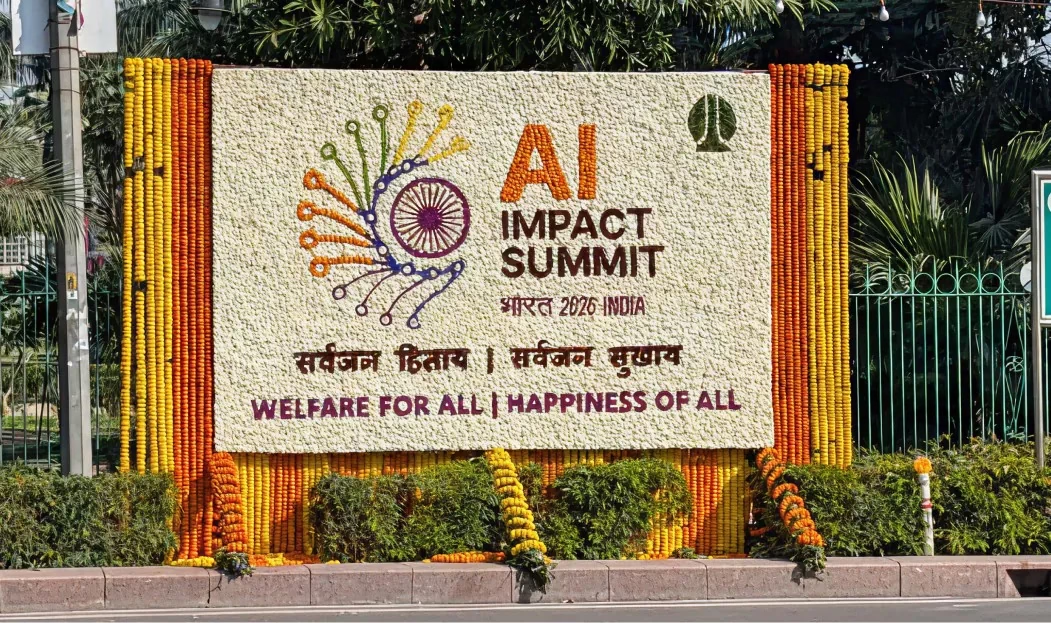
At the India AI Impact Summit 2026 in New Delhi, the Union Ministry of Health and Family Welfare outlined an ambitious roadmap to scale Artificial Intelligence (AI) across India’s public health ecosystem, positioning digital public infrastructure as the backbone of inclusive and accountable healthcare delivery.
Hosted by the Government of India from February 16–20 at Bharat Mandapam, the Summit marks the first global AI gathering of its kind to be held in the Global South. The five-day event has brought together heads of state, policymakers, global CEOs, researchers and innovators for over 500 sessions featuring more than 3,250 speakers, focusing on human-centric and responsible AI applications across sectors.
From Digitisation to Intelligent Health Systems
Delivering the keynote address, Union Health Secretary Punya Salila Srivastava said India’s healthcare transformation has moved beyond basic record digitisation toward building a nationally interoperable and intelligent digital health ecosystem.
She noted that the vision of the National Health Policy has been operationalised through the National Digital Health Blueprint, built on open standards, interoperability, privacy-by-design principles, and the adoption of emerging technologies including Generative AI.

At the centre of this transformation is the Ayushman Bharat Digital Mission (ABDM), which has emerged as a core digital public infrastructure for healthcare. According to the Ministry, the platform has enabled the creation of 859 million ABHA accounts and the digital linkage of 878 million health records. More than 1.80 lakh Ayushman Arogya Mandirs are now operational, integrating digital systems into primary care delivery.
Telemedicine at Population Scale
The Health Secretary highlighted eSanjeevani as a flagship example of large-scale digital health deployment. Supported by AI-enabled Clinical Decision Support Systems (CDSS), the platform has delivered 449 million teleconsultations with the participation of 2.2 lakh registered healthcare providers, making it the world’s largest primary healthcare telemedicine initiative.
She emphasised that AI should serve as an enabler rather than a substitute for clinicians, stating that while digital systems capture and transmit information, AI allows for intelligent interpretation and actionable insights. The goal, she said, is to reduce workforce burden while strengthening the physician–patient relationship.
Current AI use cases in public health include diabetic retinopathy screening through MadhuNetrAI, AI-enabled handheld X-ray systems, acoustic screening tools such as Cough Against TB (CA-TB), and AI-integrated disease surveillance systems designed to generate faster epidemic alerts. Centres of Excellence for AI in healthcare have been established at leading institutions including AIIMS Delhi, PGIMER Chandigarh, and AIIMS Rishikesh.
NHA: Driving Efficiency and Transparency Through AI
Dr Sunil Kumar Barnwal, CEO of the National Health Authority (NHA), underlined AI’s potential to improve efficiency and accountability in large-scale public health schemes. He said AI tools are being deployed for beneficiary identification, claims management, fraud detection, monitoring service utilisation, and strengthening performance oversight.
He stressed the importance of interoperable platforms backed by robust data governance and privacy safeguards to ensure secure and ethical AI deployment.
Launch of SAHI and BODH
A major highlight of the Summit is the launch of two national initiatives aimed at institutionalising responsible AI adoption in healthcare.
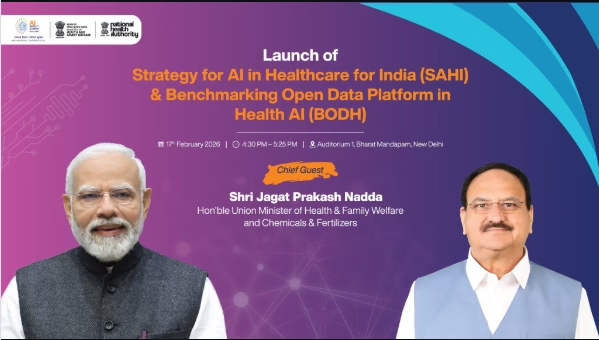
The Strategy for AI in Healthcare for India (SAHI) will serve as a strategic framework outlining governance standards, ethical safeguards, interoperability norms, and implementation priorities for integrating AI into public healthcare delivery.
Complementing SAHI is BODH the Benchmarking Open Data Platform for Health AI developed in collaboration with IIT Kanpur and the NHA. BODH is designed as a national benchmarking and validation platform where AI models can be evaluated on diverse, real-world datasets before deployment at population scale. Using federated learning frameworks that protect patient data, the platform aims to ensure transparency, safety, and performance accountability in AI-driven diagnostics, triaging, and surveillance systems.
By introducing structured benchmarking and validation mechanisms, the government seeks to consolidate fragmented AI deployments into a coordinated, standards-based ecosystem aligned with both national and international frameworks.
Ministry Showcase at Bharat Mandapam
At its exhibition stalls in Hall 1, the Ministry is demonstrating several AI-enabled solutions, including:
- An AI-powered Clinical Decision Support System featuring multilingual patient assistance forms for structured symptom capture.
- A voice-to-text digital prescription model integrated into Hospital Management Information Systems (HMIS).
- An AI-driven media surveillance tool that generates early signals of potential disease outbreaks.
- The BODH platform, formally launched at the Summit.
These demonstrations underscore the Ministry’s push toward real-time analytics, predictive monitoring, and data-driven governance.
Expanding AI Access for Medical Education
In a parallel initiative, the government is working to expand access to digital learning and AI resources for medical students, particularly in smaller towns and rural areas.
Deputy Director General (Medical Education) B Srinivas said the first phase of the initiative covers around 57 government medical colleges, where efforts are underway to provide e-books and digital clinical materials through the National Medical Library. The programme aims to bridge knowledge gaps faced by students in remote institutions and will be gradually scaled up, with private medical colleges to be included at a later stage.
Officials noted that while infrastructure development is relatively straightforward, building accessible and high-quality knowledge ecosystems requires sustained investment and innovation.
AI for Viksit Bharat @2047
Reaffirming the government’s broader vision, the Health Secretary said India’s approach to Digital Public Infrastructure under the leadership of Prime Minister Narendra Modi is anchored in inclusion and equity, aligned with the vision of Viksit Bharat @2047.
AI-supported tuberculosis screening has already contributed to improved treatment outcomes, while digital retinal screening has expanded early detection services. AI-driven surveillance systems have generated thousands of early alerts for potential outbreaks, and telemedicine platforms have facilitated hundreds of millions of consultations with AI-assisted clinical support.
The India AI Impact Summit 2026 signals India’s intention to transition from pilot deployments to a structured, evidence-based and scalable AI health ecosystem combining policy direction through SAHI and technical validation through BODH to ensure that AI adoption in public healthcare remains transparent, trustworthy and aligned with patient safety.
With global collaboration, academic partnerships and multilateral engagement, India is positioning itself as a leader in responsible, population-scale AI for public health.