


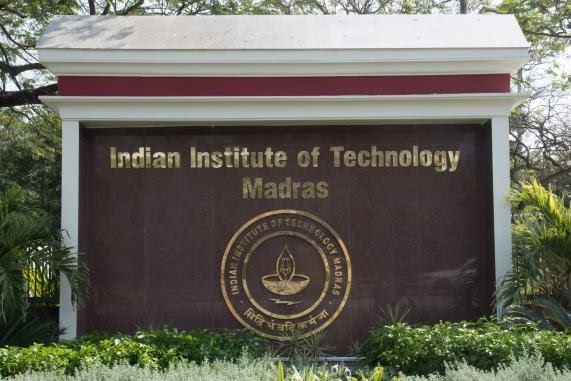
IIT Madras is preparing to expand beyond its traditional engineering and technology focus by exploring the launch of a dedicated School of Medical Sciences that could eventually offer medical degrees such as MBBS, MD and PhD. Director Professor V Kamakoti said the move is aimed at strengthening the connection between medicine, engineering and indigenous healthcare technology.
IIT Madras Eyes Full-Fledged Medical Education
Speaking to India Today, Kamakoti said IIT Madras intends to establish a School of Medical Sciences and eventually award medical degrees. The proposed expansion would mark a major shift for the premier technology institute, bringing clinical education alongside its existing strengths in engineering and research.
From Medical Technology to Medical Degrees
IIT Madras began laying the foundation for this transition in May 2023 with the creation of its Department of Medical Sciences and Technology.
The department’s four-year undergraduate programme focuses on developing graduates who understand both biological sciences and technology. The objective is to create professionals capable of working on medical devices, imaging systems, implants, software and other technologies used in healthcare.
Why IIT Madras Wants to Enter Medicine
According to Kamakoti, healthcare is becoming increasingly dependent on advanced technology, making closer collaboration between doctors and engineers essential.
He has also highlighted India’s dependence on imported high-end medical equipment. The COVID-19 pandemic, he said, demonstrated the risks associated with relying heavily on overseas technology and underlined the need to develop critical healthcare technologies within the country.
The proposed medical school could therefore provide a common environment where clinicians, engineers and researchers work together to develop indigenous healthcare solutions.
NMC Approval Will Be the Key Challenge
The proposal, however, faces an important regulatory hurdle. Medical education in India is governed by the National Medical Commission (NMC), and institutions seeking to award recognised medical degrees must meet its requirements and obtain the necessary approvals.
A teaching hospital is also a crucial requirement for medical education, as students need access to clinical training and real-patient care.
This means IIT Madras would need to establish or secure access to the required clinical infrastructure before moving from its current medical technology programmes to full-fledged medical education.
IIT Kharagpur Offers a Possible Precedent
IIT Kharagpur has already taken steps towards integrating medical education with technology. The institute received approval for a postgraduate MD programme, although its plans for an undergraduate MBBS programme have faced infrastructure-related challenges.
IIT Madras could follow a similar path, but its existing partnerships with hospitals and its Department of Medical Sciences and Technology may provide a foundation for deeper integration between engineering and clinical education.
A New Model for Medical Innovation
If IIT Madras succeeds in obtaining regulatory approval and developing the necessary infrastructure, its medical school could create a new model combining medical education, engineering and research.
The broader vision is to train professionals who can understand both the clinical needs of patients and the technology required to address them potentially strengthening India’s ability to develop and manufacture advanced healthcare technologies domestically.