
Eleven leading national associations representing medical device manufacturers, traders, healthcare providers, hospitals, clinicians, and patient advocacy groups have jointly urged the Government of India to revisit the Draft Drugs, Medical Devices and Cosmetics Bill, 2026, warning that the proposed legislation could hinder the growth of India’s medical technology sector.
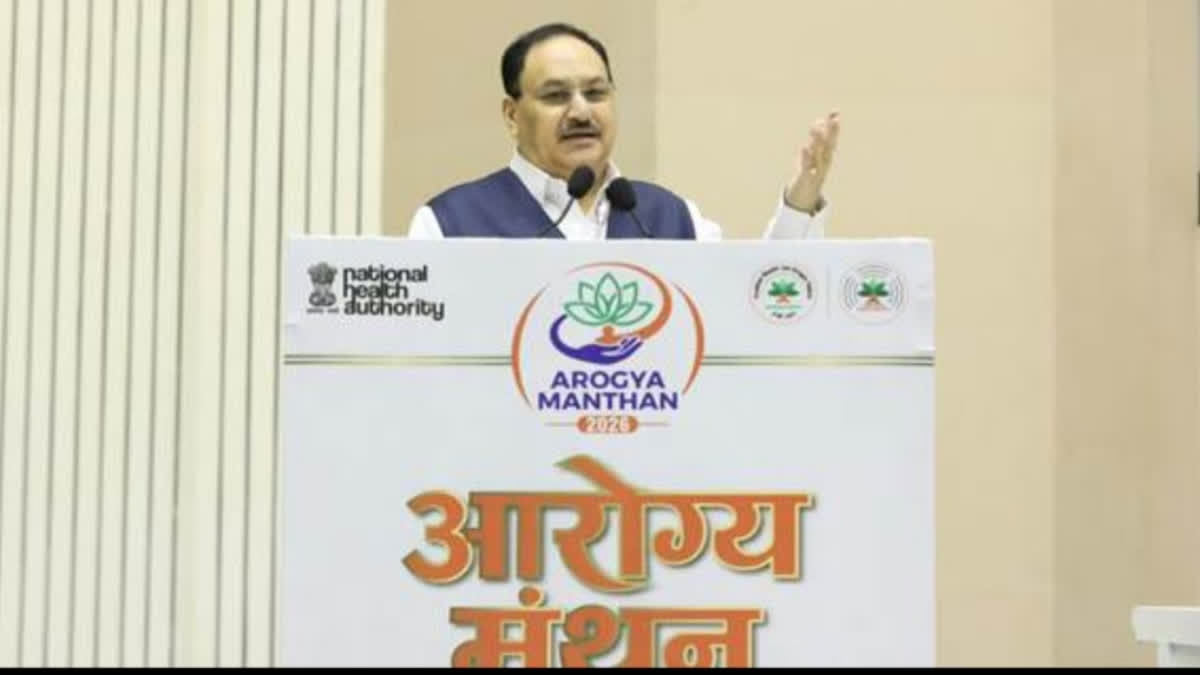
In a letter addressed to Union Health Minister JP Nadda on August 8, 2026, the associations called for a comprehensive review of the draft law and renewed their demand for a standalone Medical Devices Act. The communication was coordinated by the Association of Indian Medical Device Industry (AiMeD) following discussions with the minister during a Medical Devices Conference held at Vigyan Bhawan in New Delhi.
The industry bodies acknowledged the government’s efforts to strengthen healthcare manufacturing and highlighted the potential for India to emerge as a global medical device hub. They noted that reducing import dependence and boosting exports would require a regulatory framework specifically designed for the unique nature of medical devices.
Concerns Over Pharma-Centric Regulation
According to the associations, the draft legislation continues to regulate medical devices under a framework largely designed for pharmaceuticals, despite significant differences between the two sectors. They argued that medical devices are engineering-based products that require risk-based regulation, quality management systems, post-market surveillance, and corrective actions rather than the criminal provisions commonly applied to drug-related violations.
The letter expressed concern over provisions that prescribe imprisonment for technical non-compliances such as labeling errors, documentation lapses, licensing irregularities, and reporting deficiencies, even when no patient harm has occurred. The associations stated that major global regulators, including those in the United States, European Union, United Kingdom, Japan, and Australia, generally rely on administrative enforcement mechanisms instead of criminal penalties for such issues.
Industry representatives also raised objections to expanded enforcement powers proposed under the bill, including arrest provisions and immediate cessation orders. They warned that such measures could discourage investment, innovation, and entrepreneurship, particularly among small and medium-sized enterprises operating in the medical technology sector.
Demand for a Dedicated Medical Devices Authority
A major concern highlighted in the letter is the absence of an independent regulatory authority dedicated to medical devices. The associations argued that the existing drug-regulatory structure lacks the specialized technical expertise required to oversee increasingly complex medical technologies.
They further pointed out that the draft bill does not adequately address key device-specific regulatory concepts such as biocompatibility standards, software safety requirements, usability engineering, remanufacturing provisions, and international pathways for product equivalence assessments. The groups also criticized the proposal for applying uniform penalties across all device categories, regardless of their risk profile.
Support from Earlier Policy Recommendations
The associations cited recommendations from Parliamentary Standing Committee Reports 138 and 146, NITI Aayog’s Draft Medical Devices (Safety, Effectiveness and Innovation) Bill, 2019, and global regulatory principles promoted by the World Health Organization. These recommendations have consistently advocated a separate legislative and regulatory framework for medical devices.
Prof. Bejon Kumar Misra, Founder of the Patient Safety and Access Initiative of India Foundation, emphasized that medical devices should be regulated through a modern, risk-based system that promotes innovation while ensuring patient safety.
Similarly, Puneet Bhasin, President of the Surgical Manufacturers & Traders Association, cautioned that retaining medical devices within a drug-focused law could increase compliance burdens for manufacturers, especially MSMEs, potentially affecting competitiveness and raising healthcare costs.
Key Demands Submitted to the Government
The associations have urged the government to establish a new expert committee comprising biomedical engineers, clinicians, industry representatives, patient groups, and regulatory specialists to review the proposed legislation. They have also called for:
- Enactment of a separate Medical Devices Act aligned with international best practices.
- Decriminalization of technical and non-intentional compliance violations.
- Creation of an autonomous National Medical Devices Regulatory Authority.
- Adoption of risk-based regulatory and enforcement mechanisms.
- Broader stakeholder consultations before finalizing the legislation.
The industry bodies said they remain optimistic about further engagement with the Ministry of Health and Family Welfare, noting that government officials have assured stakeholders that their concerns will be examined through a structured consultation process.
AiMeD Forum Coordinator Rajiv Nath said that India’s ambition to become a global medical device manufacturing powerhouse would require a modern and independent regulatory framework that encourages innovation, investment, and patient safety. He stressed that a dedicated Medical Devices Act is essential to support the goals of Make in India and Atmanirbhar Bharat.