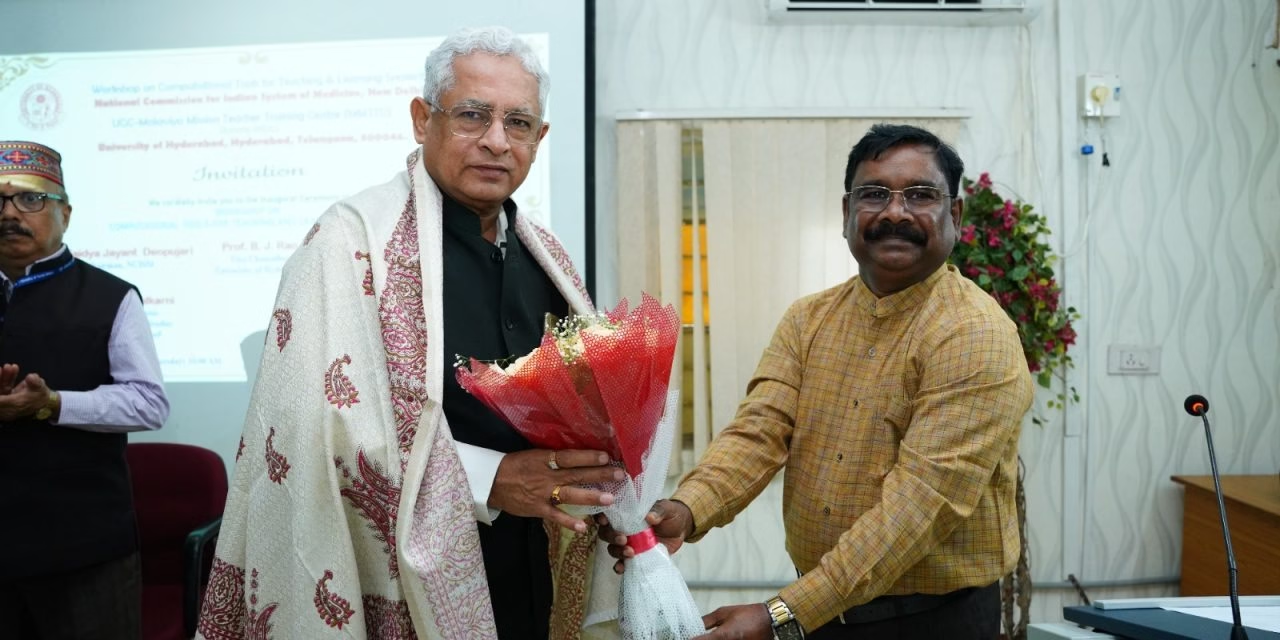
On June 6, the Delhi High Court annulled the appointment of Vaidya Jayant Yeshwant Deopujari as Chairperson of the National Commission for Indian System of Medicine (NCISMC), citing that he was not eligible under the law.
A bench comprising Chief Justice Devendra Kumar Upadhyaya and Justice Tushar Rao Gedela allowed two petitions filed by Ved Prakash Tyagi, former president of the now-defunct Central Council for Indian Medicine, and Dr. Raghunandan Sharma. The court issued a writ of quo warranto, a legal order used to challenge the authority of someone holding public office thereby invalidating Deopujari’s appointment.
The Ministry of Personnel had appointed Deopujari on June 9, 2021, but the petitioners argued that he did not meet the eligibility criteria outlined in the National Commission for Indian System of Medicine Act, 2020 (NCISM Act). Specifically, the Act mandates that the chairperson must possess a postgraduate degree such as an MD or equivalent master’s degree in any Indian System of Medicine discipline.
The court observed that Deopujari held a PhD from Pune University, which he pursued directly after his undergraduate degree in Ayurveda (BAMS), bypassing a master’s degree. The judges emphasized that in the context of Indian higher education, a postgraduate degree implies a master’s qualification (e.g., MD, MA, MSc, LLM), and not just any degree obtained after graduation. Therefore, the court ruled that Deopujari lacked the essential educational qualification to hold the post.
Further, the bench rejected the argument that his work in a private Ayurvedic pharmaceutical company qualified as experience equivalent to leading a department or organization, as required by the Act. The court emphasized that roles described in the Act should be understood within the broader purpose of the Commission maintaining high standards in Indian medicine education and practice.
Although the Centre contended that Deopujari’s appointment was made on the recommendation of a high-powered search committee led by the Cabinet Secretary, the court noted that such recommendations cannot override statutory requirements. It reiterated that legal eligibility, not institutional endorsement, is the deciding factor.
The court has directed the government to expedite the process of appointing a new, eligible chairperson and to consider its observations during the selection.
Tyagi had stressed in his petition that allowing an unqualified individual to lead such an important regulatory body could harm the education and future of thousands of Indian medicine students and practitioners.