


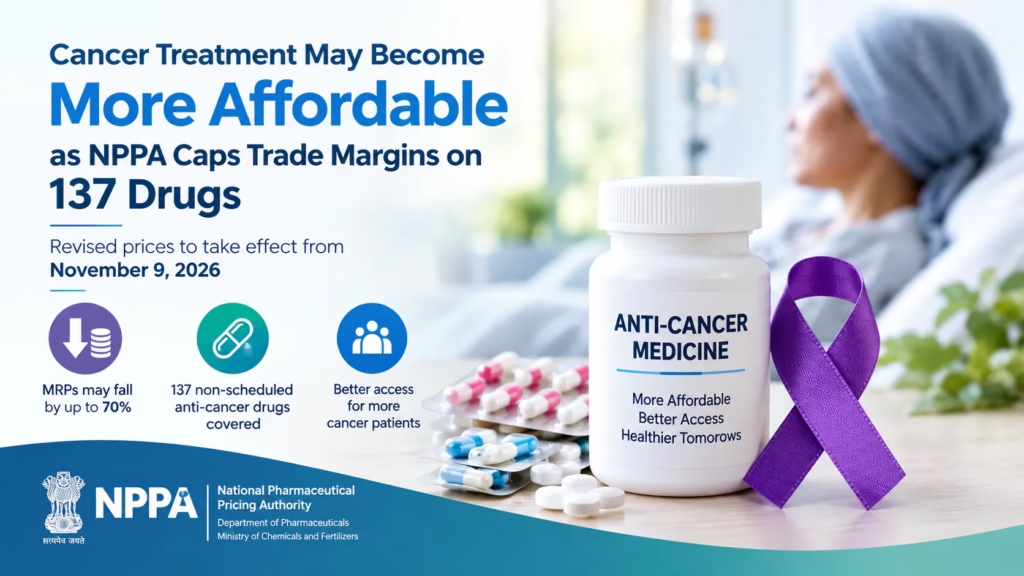
Revised prices to take effect from November 9, 2026; MRPs of selected anti-cancer medicines expected to fall by up to 70%
In a significant move to reduce the financial burden of cancer treatment, the National Pharmaceutical Pricing Authority (NPPA) has introduced Trade Margin Rationalisation (TMR) for 137 identified non-scheduled anti-cancer drugs. The initiative aims to curb excessive trade margins across the medicine distribution chain, improve affordability and ensure better access to essential cancer medicines.
The revised prices are scheduled to take effect from November 9, 2026. Depending on the existing price structure of individual medicines, patients could see reductions in maximum retail prices (MRPs) of up to 70%.
Major Cancer Medicines Included in the Initiative
The list of 137 medicines covers a range of treatments used for different types of cancer. These include immunotherapy drugs used against more than 20 types of cancer, Denosumab for certain breast and prostate cancer patients, Pegfilgrastim to help prevent neutropenia associated with cancer treatment, and Bevacizumab, which is used for several cancers, including colorectal, ovarian and cervical cancer.
The initiative is also expected to improve affordability for patients using widely prescribed anti-cancer medicines such as Pembrolizumab, Durvalumab and Osimertinib.
Under the new measure, NPPA has capped trade margins at 30% of the maximum retail price for the identified medicines, exercising its powers under Paragraph 19 of the Drugs (Prices Control) Order (DPCO), 2013. The drug list was recommended by an expert committee under the Directorate General of Health Services (DGHS), comprising oncologists, medical specialists, hospital experts and government representatives. The list may be updated periodically.
Builds on Earlier Price-Control Measures
The latest decision builds on NPPA’s 2019 pilot initiative, when trade margins for 42 anti-cancer drugs were capped at 30%. Following that exercise, the MRPs of 526 brands of non-scheduled anti-cancer medicines were reduced by as much as 90%.
The expansion to 137 drugs seeks to extend the benefits of trade margin regulation to a broader range of cancer treatments while balancing patient affordability with the need to maintain a stable supply of medicines.
Manufacturers, Retailers and Hospitals to Follow Revised Prices
Manufacturers must submit their revised prices to NPPA within seven days of the publication of the Gazette notification dated October 17, 2026. They must also publish the updated price lists on their websites and circulate them to retailers and hospitals.
From November 9, 2026, retailers, hospitals and medical institutions will be required to charge the revised prices and display the updated price lists in their pharmacies. Hospitals must also prominently publish the revised prices on their websites.
Since a substantial proportion of anti-cancer medicines is supplied directly to hospitals and medical institutions, these institutions will have an important role in ensuring that patients receive the benefit of the revised prices from the implementation date.
State Drug Controllers will monitor compliance by manufacturers, distributors, retailers, hospitals and other medical institutions. Pharmaceutical companies are also expected to maintain existing production and supply levels to prevent shortages or interruptions in treatment.
Patients Can Check Updated Medicine Prices
Patients and their families will be able to verify revised medicine prices through the NPPA’s official website, nppa.gov.in, and the Pharma Sahi Daam mobile application.
The measure is intended to address excessive trade margins without disrupting the legitimate supply of medicines. By bringing down the cost of selected anti-cancer drugs, the government aims to ease out-of-pocket expenditure for patients and families and strengthen equitable access to cancer care across the country.
Expert Response
Dr. Shuchin Bajaj, Founder Director, Ujala Cygnus Healthcare Services welcomes this and said cancer is not just a medical diagnosis; for millions of Indian families, it is also a financial crisis. No patient should have to abandon potentially life-saving treatment because medicines are unaffordable.
However, affordability must be addressed across the entire pharmaceutical value chain. The objective should be to ensure that the benefits of lower prices actually reach patients, while preserving the availability of quality medicines and the sustainability of cancer care delivery.
We must also recognise that the cost of cancer treatment extends beyond medicines to diagnostics, surgery, radiation, hospitalisation and supportive care. A comprehensive approach involving rational drug pricing, stronger insurance coverage, early detection and decentralised cancer services is essential.
The ultimate measure of success will not simply be how much medicine prices fall, but how many more patients can access and complete their cancer treatment without suffering financial hardship.”