


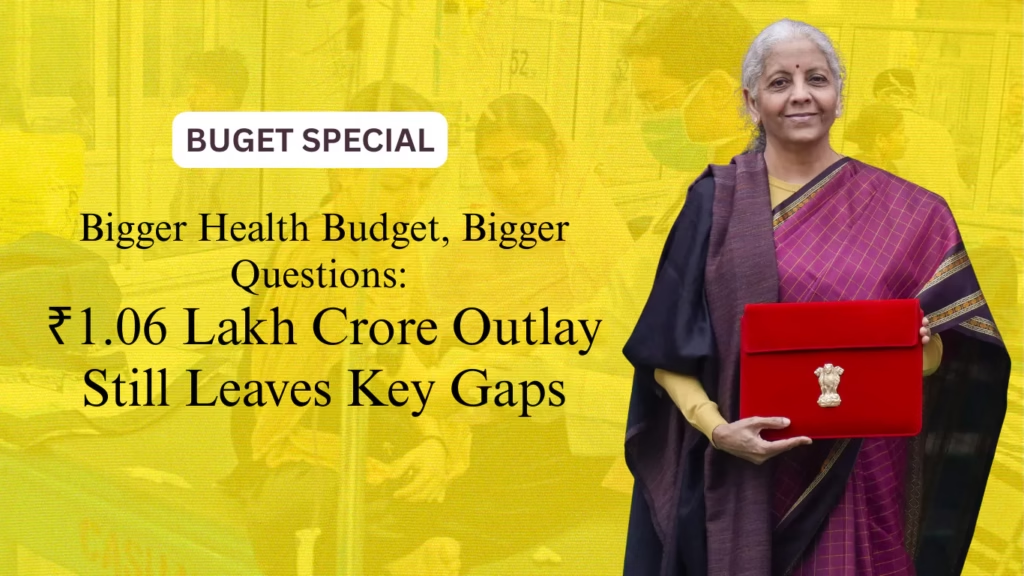
The Union Budget 2026–27 has placed healthcare at the centre of India’s development agenda, raising the allocation for the Ministry of Health and Family Welfare (MoHFW) to ₹1,06,530.42 crore a nearly 10% increase over the Revised Estimates of FY 2025–26. The government highlighted that health spending has grown cumulatively by over 194% in the last 12 years, underscoring its long-term commitment to strengthening healthcare infrastructure, medical education, research and affordability.
Presenting the Budget in Parliament, Finance Minister Nirmala Sitharaman outlined a wide-ranging roadmap aimed at advancing universal health coverage, expanding tertiary care capacity, boosting biomedical research and reducing out-of-pocket expenditure. The Department of Health Research received over ₹4,821 crore, registering a 24% increase, while the scheme component under MoHFW rose by more than 10%.
Big Push for Infrastructure, AIIMS, and Research
A major highlight of the Budget is the sharp enhancement in allocations for healthcare infrastructure. The Ayushman Bharat Health Infrastructure Mission (PM-ABHIM) saw a 67.66% jump to ₹4,770 crore, aimed at expanding critical care blocks, public health laboratories and district-level hospital infrastructure. Similarly, funding under the Pradhan Mantri Swasthya Suraksha Yojana (PMSSY), including new AIIMS, increased to ₹11,307 crore to support new institutions, operationalisation of existing AIIMS and upgradation of government medical colleges.
The Budget also announced investments in cancer centres, trauma and emergency care services, super-specialty blocks, transplant units, robotic surgery facilities and AI-enabled medical institutions. Expansion of MBBS, postgraduate, super-specialty and nursing seats was projected as a key step to address future workforce needs.
Medical research received a strong boost, with the Indian Council of Medical Research allocation rising nearly 27% to ₹4,000 crore. The launch of the ₹10,000 crore ‘Bio Pharma Shakti’ initiative aims to strengthen India’s ecosystem for biologics, biosimilars, clinical trials, and advanced pharmaceutical manufacturing, while reducing import dependence.
Public Health and Digital Health Gains
Allocations for public health programmes also increased. The National AIDS and STD Control Programme budget rose by over 30% to ₹3,477 crore, including a major boost for blood transfusion services. The Ayushman Bharat Digital Mission received ₹350 crore to expand digital health records, interoperability, and telemedicine services.
To reduce treatment costs, the Budget proposed full customs duty exemption on 17 life-saving cancer drugs and expanded duty relief for additional rare diseases.
What the Budget Still Falls Short On
Despite the substantial increase in allocations and ambitious announcements, health policy experts point out that key structural gaps remain unaddressed.
Even with the enhanced outlay, India’s public health spending remains around 2.1–2.2% of GDP, still below the National Health Policy target of 2.5% and far short of the WHO-recommended 3%. The Budget does not outline a time-bound roadmap to raise health expenditure as a share of GDP.
While tertiary care and medical institutions dominate the announcements, primary healthcare and preventive services receive relatively limited emphasis. Health and Wellness Centres, urban primary care, and community-based disease prevention initiatives remain largely folded within existing NHM allocations, without a visible expansion strategy.
The expansion of medical and allied health education is expected to improve capacity, but issues related to recruitment, deployment, rural retention and uneven distribution of healthcare workers across states remain unresolved. Experts note that increasing seats alone may not address shortages in underserved regions.
Mental healthcare, despite announcements for new institutions and upgradation of select centres, lacks a clearly defined, population-level financing strategy, particularly for district and community-based mental health services.
Similarly, while customs duty exemptions on select drugs offer relief, out-of-pocket expenditure driven largely by medicine costs and diagnostics remains structurally high, with no major expansion announced for free drugs and diagnostics schemes.
Another concern is the absence of a strengthened framework for state-level flexibility and untied health grants, even as states continue to shoulder the bulk of healthcare delivery. The Budget also stops short of introducing outcome-linked financing or public dashboards to track quality, access and impact of health spending.
Balancing Ambition with Access
The Union Budget 2026–27 clearly signals ambition, scale and continuity in healthcare investments, particularly in infrastructure, research and advanced medical care. However, analysts caution that without a stronger push for primary care, preventive health, workforce deployment and fiscal federalism, the gains may remain uneven.
As India moves towards the vision of Viksit Bharat@2047, the challenge will be to ensure that rising allocations translate not only into world-class institutions, but also into accessible, affordable and equitable healthcare at the community level.