


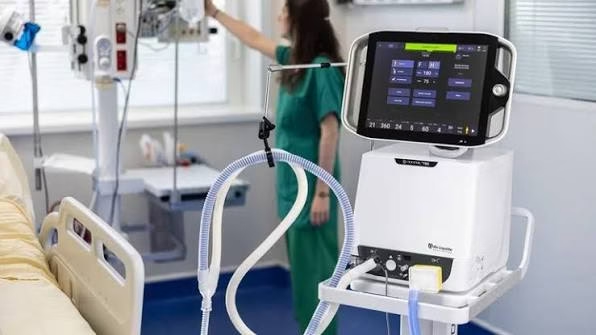
The Allahabad High Court has directed the Additional Chief Secretary/Principal Secretary of Uttar Pradesh’s Medical Health and Family Welfare Department to appear before the court on August 6 and provide comprehensive details regarding the availability of ventilators in government hospitals across the state.
The direction was issued by a Lucknow Bench comprising Justice Rajan Roy and Justice Manjive Shukla while hearing a public interest litigation (PIL) filed by a non-governmental organisation. The order, passed on July 16 and uploaded on July 27, expressed dissatisfaction with the state government’s response, describing its affidavit as inadequate and lacking crucial information.
The court noted that in an earlier order dated April 22, it had sought specific details regarding the actual requirement of ventilators in government hospitals, the number of patients who were unable to receive ventilator support when needed, and the measures in place to address such shortages. However, despite nearly three months having passed, the state government failed to provide substantive data, stating only that information was still being collected from various hospitals.
The bench also observed that the affidavit did not clearly explain healthcare budget allocations, the functioning of recently established medical colleges, or how effectively these institutions were addressing local healthcare needs. Calling the response unsatisfactory, the court ordered the personal appearance of the senior health department official to present factual and complete information.
Additionally, the court directed the Sanjay Gandhi Postgraduate Institute of Medical Sciences (SGPGI), Lucknow, along with other major hospitals, to evaluate ventilator demand and availability based on data from the last two years and determine the number of additional ventilators required to meet actual patient needs.
In its earlier observations, the High Court had emphasised that healthcare spending should remain a top priority for the state, as it is intrinsically linked to the fundamental right to life. The court had also sought responses from both the Centre and the state government on issues such as regulation of private hospitals, decentralisation of super-speciality healthcare services, and the availability of specialist doctors across the state.