


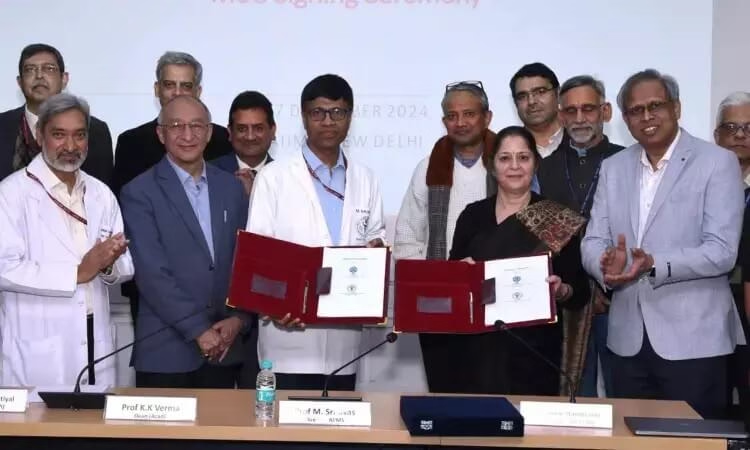
India’s growing human spaceflight ambitions have brought together two leading institutions the All India Institute of Medical Sciences (AIIMS) and the Indian Space Research Organisation (ISRO). The two organisations on March 09 signed an agreement to collaborate on space medicine research, focusing on how the human body responds to space conditions and how those findings can benefit healthcare on Earth.
The collaboration with ISRO’s Human Space Flight Centre will enable both ground-based and space-based research in areas such as human physiology, cardiovascular and autonomic regulation, musculoskeletal health in microgravity, microbiome and immunology, genomics, biomarkers and behavioural health.
Explaining the significance of such research, Prof. K K Deepak, former head of physiology at AIIMS, said studying how the body behaves in space can also help scientists better understand diseases on Earth. In microgravity, astronauts experience muscle loss, bone weakening and fluid shifts changes that resemble accelerated ageing. Research on these processes could offer insights into age-related problems affecting muscles, bones and circulation.
He added that technologies developed to counter such effects in astronauts, including devices that improve blood flow in the legs, may also help patients suffering from circulation problems and muscle weakness.
AIIMS director Prof. M Srinivas said the partnership would open new avenues in medical science. “This MoU will give us the escape velocity to venture into space medicine. Research between AIIMS and ISRO will benefit patients, the nation and ultimately humankind,” he said.
Addressing the event, ISRO chairman V. Narayanan recalled the journey of India’s space programme from the early days when rockets and equipment were transported on bicycles and bullock carts to the present when the country is recognised globally for its space technology. He said collaborations with institutions such as AIIMS will play an important role in strengthening India’s human spaceflight capabilities.
The memorandum of understanding was signed by Prof. Srinivas and Dinesh Kumar Singh, director of the Human Space Flight Centre, in the presence of senior officials, faculty members and students. Officials said the partnership marks a significant step toward strengthening India’s capabilities in both human spaceflight and biomedical research.