


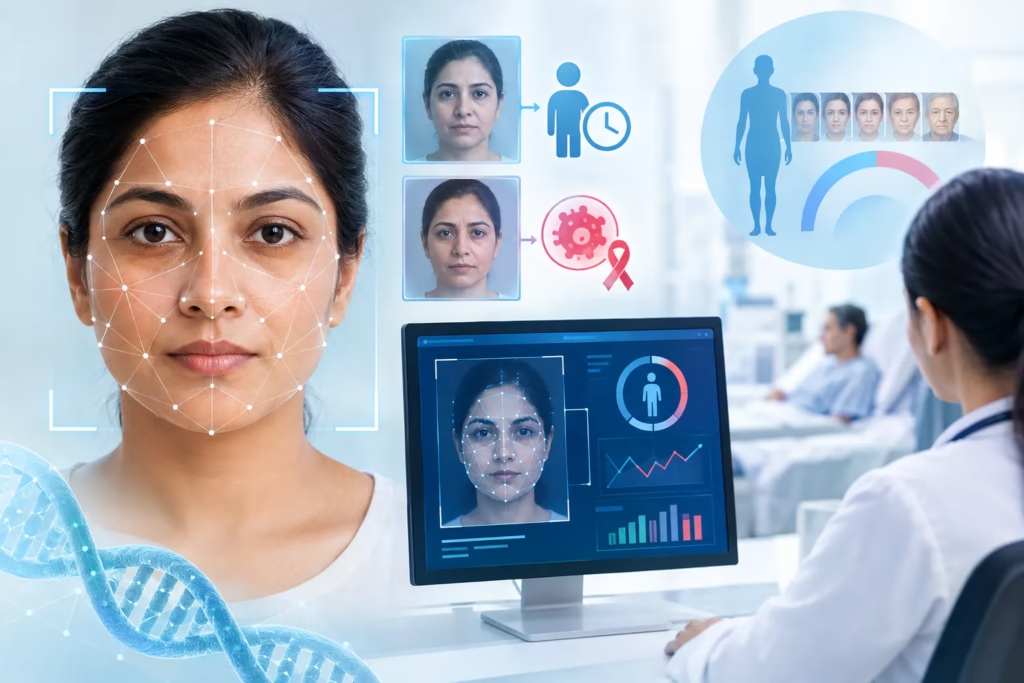
Researchers have developed an artificial intelligence (AI) model capable of analysing facial photographs to estimate biological age and assess survival risks among cancer patients. The technology could provide an additional tool for evaluating patient health and supporting clinical decision-making.
The findings, published in The Lancet Digital Health in 2026, suggest that facial characteristics may contain information associated with biological ageing and survival outcomes.
AI Trained on Over 40 Million Facial Images
The model, known as Foundation Artificial Intelligence for Health Recognition-Face (FAHR-Face), was initially trained using more than 40 million facial photographs. Researchers subsequently adapted the system to estimate biological age and evaluate mortality risk.
During testing on publicly available photographs, the model estimated biological age with an average error of approximately five years.
Researchers also examined data from 38,183 patients receiving treatment at six US medical centres affiliated with Harvard. The analysis found that patients whose facial appearance suggested a biological age higher than their chronological age generally experienced poorer survival outcomes.
Cancer Patient Data Used to Evaluate Survival Predictions
A separate model, FAHR-FaceSurvival, was developed using facial images from 34,363 cancer patients and subsequently evaluated on an independent group of 3,820 patients.
The findings showed that individuals placed in the highest-risk category had more than three times the risk of death compared with those in the lowest-risk category, even after accounting for demographic and clinical factors.
Researchers further assessed the technology using data from 4,892 cancer patients in the Netherlands. The results indicated that the model could potentially estimate survival risks across different patient groups.
Combining the two AI models improved survival-risk predictions, suggesting that biological ageing indicators and other facial characteristics may provide complementary information about patient health.
Indian Experts Highlight Need for Population-Specific Validation
Dr Mandeep Singh Malhotra, Director of Surgical Oncology at CK Birla Hospital, Delhi, said the development presents an interesting possibility for cancer care, although its accuracy among Indian patients remains uncertain.
He highlighted the importance of evaluating the technology in India’s diverse population, considering differences in facial characteristics and disease patterns.
According to Malhotra, facial analysis could eventually support precision oncology when integrated with established diagnostic methods such as genomic testing and liquid biopsy.
Such integration may help improve survival-risk assessment, support earlier identification of cancer recurrence and assist clinicians in planning timely interventions.
Further Clinical Validation Required
Despite the encouraging findings, researchers emphasised that the technology is not designed to diagnose cancer or determine an individual’s exact lifespan.
The studies primarily involved patients from the United States and the Netherlands, making further evaluation necessary before the results can be generalised to other populations.
Factors including lighting conditions, facial expressions and photograph quality may also influence the model’s estimates.
The technology remains a research-stage approach, and additional clinical validation will be required before facial-image analysis can become part of routine cancer care.