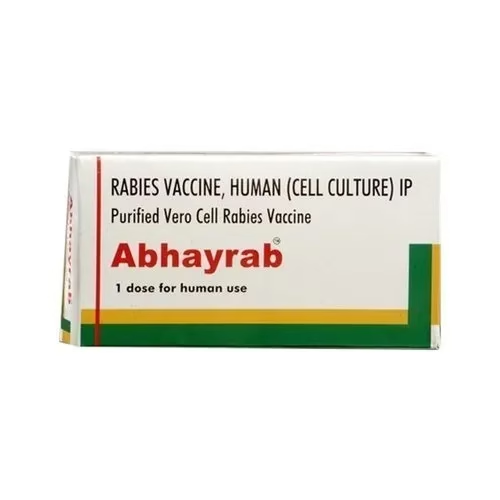
Amid international advisories urging caution for travellers vaccinated against rabies in India due to reports of counterfeit vaccines, Indian Immunologicals Limited (IIL) has issued a comprehensive clarification, affirming that Abhayrab remains safe, effective and of assured quality when obtained through authorised supply channels.
The clarification follows recent alerts from overseas health regulators and immunisation advisory bodies, which cautioned travellers to India to verify their rabies vaccination status. These advisories were triggered by reports suggesting the circulation of counterfeit versions of the rabies vaccine Abhayrab in the country.
According to these global agencies, identifying genuine doses from counterfeit ones can be challenging. They warned that inadequate post-exposure prophylaxis against rabies can be fatal, underscoring the seriousness of the issue.
The advisories stated that the counterfeit vaccine differed from the approved product in terms of formulation, packaging, labelling and manufacturing. Individuals who may have received fake doses were advised to take replacement vaccinations to ensure adequate protection. While rabies infection is almost invariably fatal, regulators noted that the actual incidence of rabies among travellers remains extremely rare.
They further indicated that travellers could be at risk if they received rabies vaccination in India from November 1, 2023 onwards and were administered one or more doses of Abhayrab, or if the brand of vaccine administered was unknown.
Responding to these concerns, IIL clarified that the issue originated from a single identified case. In January 2025, the company detected a batch labelled KA24014 that had packaging variations when compared to the original product.
IIL stated that it took immediate corrective action upon identifying the anomaly. The company promptly informed drug regulatory authorities and law enforcement agencies, filed a formal complaint, and coordinated closely with officials to ensure swift investigation and action.
Clarifying the scope of the matter, IIL said that batch KA24014 was legitimately manufactured and distributed across multiple regions of India through the company’s authorised distribution network, and that no adverse market complaints were reported in connection with this batch.
“This further reinforces the safety, quality and efficacy of vaccines supplied through IIL’s authorised channels. There has been no report of any counterfeit batch in the market other than batch KA24014,” the company stated.
Highlighting its track record, IIL noted that Abhayrab is India’s first Vero cell rabies vaccine and has been manufactured by the company since 2000. Over the past two decades, more than 210 million doses have been supplied in India and 43 other countries. Abhayrab continues to be the market leader in India with an estimated 40 percent market share.
On regulatory compliance, the company emphasised that all its vaccines are developed, manufactured and released strictly in accordance with the Drugs and Cosmetics Act, 1940 and related rules. Each batch undergoes stringent internal quality testing and is released only after independent testing and certification by the Central Drugs Laboratory, as mandated by regulators.
IIL reassured healthcare professionals, regulators and the public that its pharmacovigilance and quality assurance systems remain robust, and that confidence can be maintained in vaccines supplied directly by the company and through its authorised partners.
Headquartered in Hyderabad, Indian Immunologicals Limited is a “One Health” organisation and among Asia’s largest vaccine manufacturers. Established by the National Dairy Development Board in 1982, IIL operates multiple GMP-certified manufacturing facilities, exports to over 60 countries, and has a strong R&D pipeline. The company produces a wide range of human and animal vaccines, including inactivated, live viral, recombinant, conjugate, toxoid and bacterial vaccines, with a focus on affordability and public health impact.
What Nimesulide Reveals About Patient Safety
The recent government decision to ban Nimesulide doses above 100 mg in India has once again highlighted the uneven nature of global drug regulation. Nimesulide, an NSAID developed in Italy in the 1980s, has faced varying regulatory outcomes worldwide due to concerns over liver toxicity.
While countries like the US, Canada, Australia and Japan never approved the drug, several European nations withdrew it after post-marketing safety data emerged. India approved Nimesulide in 1995, later banned its use in children, and has now restricted higher doses reflecting a gradual, reactive regulatory approach.
The case underscores a critical reality: there is no uniform global drug safety standard. Patient protection depends heavily on the strength of regulatory systems and pharmacovigilance. For India, the Nimesulide experience reinforces the need for periodic review of older drugs, stronger post-marketing surveillance, and transparent, evidence-based decision-making to ensure patient safety remains paramount.