


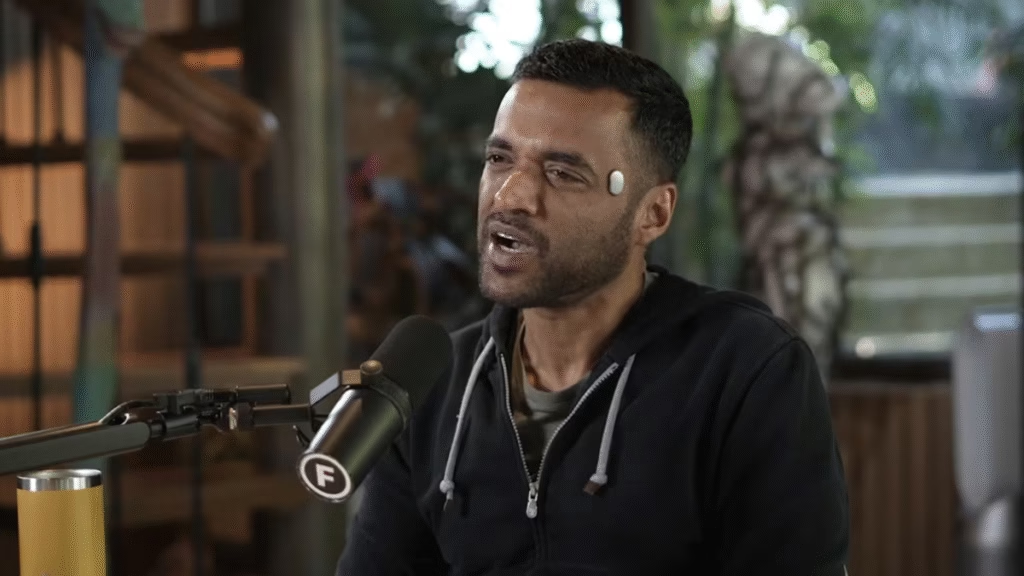
When Zomato founder and Eternal CEO Deepinder Goyal appeared on entrepreneur Raj Shamani’s Figuring Out podcast, viewers expected a deep dive into startups, leadership, and long-term thinking. Instead, what stole the spotlight was a small metallic device clipped to the side of Goyal’s head.
Within hours of the episode going live, social media users zoomed in on the mysterious gadget resting on his temple. Memes followed swiftly. Some joked it looked like chewing gum stuck to his face, others compared it to an external hard drive or a “brain charger” storing billion-dollar ideas. Searches for “Deepinder Goyal temple device” surged overnight, turning a four-hour podcast into an internet guessing game.
But behind the humour was a serious experiment.
What Is the Device?
The gadget is called Temple, an experimental wearable designed to continuously monitor cerebral blood flow the circulation of blood in the brain in real time. According to Goyal, brain blood flow is a critical marker of neurological health, cognitive function, and ageing.
Temple is not a consumer product, nor is it linked to Zomato. It is a research prototype developed under a privately funded initiative called Continue Research, backed personally by Goyal.
The version seen on the podcast is a lightweight, clip-like sensor worn on the temple area. Goyal revealed that he has been testing the device on himself for nearly a year.
The Idea Behind Temple
Goyal says the concept emerged from years of personal health optimisation, which included tracking biological markers, fasting routines, meditation, supplements, and other longevity-focused practices. This journey eventually led him to explore what he calls the Gravity Ageing Hypothesis.
The hypothesis suggests that gravity, over decades, may place chronic stress on the cardiovascular system, subtly affecting the heart’s ability to pump sufficient blood to the brain and potentially accelerating certain aspects of ageing. Goyal has clarified that gravity is not being presented as the sole cause of ageing, nor as settled science.
Temple, he says, is a tool designed to test whether long-term changes in brain blood flow could play a meaningful role in how humans age.
Serious Money, Experimental Science
Reports indicate that Goyal has invested around $25 million (over Rs 200 crore) of his personal wealth into Continue Research. The effort is positioned as curiosity-driven science rather than a commercial product launch. While there has been speculation about future funding rounds and early-access rollouts, Temple currently has no launch date, price, or regulatory approval pathway.
Medical Experts Urge Caution
As excitement grew online, medical professionals were quick to inject realism into the conversation.
Several doctors pointed out that true cerebral blood flow is typically measured using advanced imaging techniques like MRI, not surface-level wearables. Neurosurgeon Dr Vishwanathan Iyer noted that a sensor placed on the temple can only capture indirect or superficial signals, which should not be mistaken for actual measurements of brain circulation.
Others questioned the scientific foundation of the Gravity Ageing Hypothesis itself. Assistant Professor of Medicine Dr Sumol Ratna described it as an unproven idea that currently lacks support from mainstream clinical research.
Perhaps the strongest criticism came from Dr Datta, an AIIMS Delhi physician-scientist, who publicly stated that the device has “zero scientific standing as a useful tool” at present, warning people not to spend money on what he described as “fancy toys billionaires can afford.”
Neurologists also pushed back against linking gravity to ageing, noting that ageing is driven by complex cellular, molecular, and vascular processes and that humans continue to age even in microgravity environments, such as space.
Where Things Stand
For now, Temple remains firmly in the research zone an ambitious personal experiment rather than a proven medical device. While the science of brain health and blood flow is undeniably important, experts agree that wearable technology is still far from delivering clinical-grade insights.
What is clear, however, is that a tiny clip on a podcast managed to ignite a global conversation one that moved swiftly from memes to medicine. Whether Temple evolves into a genuine breakthrough or remains a billionaire-backed experiment, the internet will be watching closely. And joking faster.