
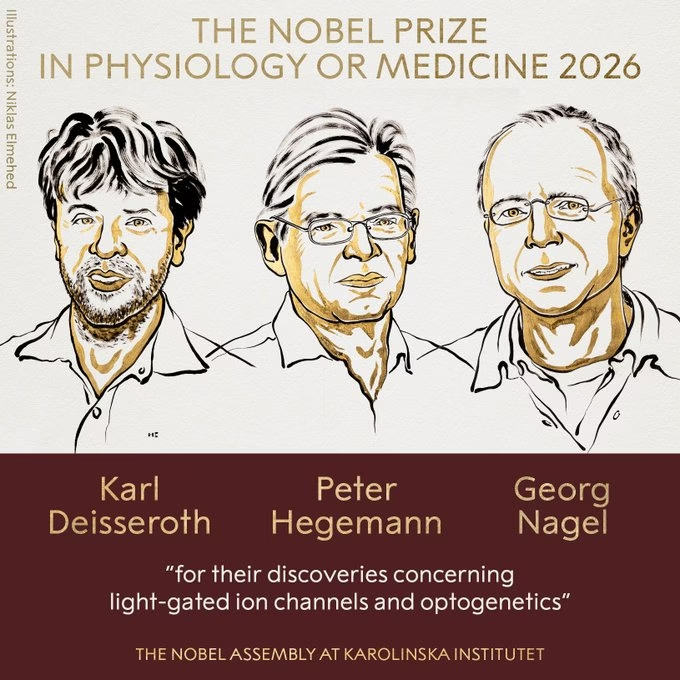
The 2026 Nobel Prize in Physiology or Medicine has been awarded to Karl Deisseroth, Peter Hegemann and Georg Nagel for discoveries that enabled scientists to control nerve cells using light.
The Nobel Assembly at Karolinska Institutet announced the award on October 5, recognising their work on light-gated ion channels and optogenetics.
Their research transformed a discovery involving light-sensitive proteins in single-celled algae into a powerful technique for investigating the living brain.
From algae to neuroscience
The scientific journey began with Peter Hegemann’s research into how the single-celled alga Chlamydomonas responds to light. Working with Georg Nagel, he helped identify channelrhodopsin, a light-sensitive protein that allows charged ions to pass through a cell membrane when activated by light.
The discovery provided scientists with a way to make cells responsive to light.
Karl Deisseroth subsequently demonstrated how the technology could be adapted to nerve cells. In 2005, his team showed that blue light could activate modified neurons and trigger nerve signals. In 2007, the approach was demonstrated in the brains of living mice.
The technique became known as optogenetics.
Changing how scientists study the brain
Traditional neuroscience methods often made it difficult to determine whether a particular group of neurons directly caused a specific behaviour or response. Optogenetics offered a more precise approach by allowing researchers to activate or inhibit selected nerve cells with light.
The method has since been widely used to investigate neural circuits associated with memory, emotions, behaviour and neurological and psychiatric disorders.
The Nobel Committee described optogenetics as opening new opportunities for mapping and understanding the brain.
Potential for medical applications
Beyond laboratory neuroscience, optogenetics is also being investigated for potential clinical applications. Researchers are exploring whether light-controlled neural activity could help restore vision and address certain neurological conditions.
The 2026 Nobel recognition therefore highlights a discovery that began with fundamental research into an alga but developed into a technology with broad implications for neuroscience and medicine.
About the laureates
Karl Deisseroth, born in 1971, is a professor at Stanford University and an investigator with the Howard Hughes Medical Institute. His work was central to turning light-sensitive proteins into practical tools for controlling neural activity.
Peter Hegemann, born in 1954, is a Hertie Senior Professor of Neuroscience at Humboldt University of Berlin. His research into light perception in algae led to key discoveries behind channelrhodopsin.
Georg Nagel, born in 1953, is a professor of molecular plant physiology at the University of Würzburg. His research with Hegemann helped establish how channelrhodopsin responds to light and transports ions across cell membranes.
Together, their work established the scientific foundation for optogenetics and provided researchers with a new way to examine how the brain’s neural circuits function.