
A report by Sugandh Khandelwal.
India’s next major hospital expansion cycle is increasingly moving away from the traditional metropolitan centres. But the story is more nuanced than simply saying that hospital chains are “betting big” on Tier-2 India. The real question is whether these new beds can achieve the occupancy, pricing and clinical depth required to generate sustainable returns.
The evidence so far is encouraging, but uneven.
The organised hospital sector entered FY27 with healthy demand and relatively strong occupancy. ICRA’s latest assessment of 11 listed hospital companies puts FY26 occupancy at 63.5%, while industry revenues grew 18%. It expects revenue growth of 13–15% in FY27supported by further bed additions and the gradual ramp-up of newly commissioned capacity.
At the same time, more than 10,000 new beds are expected to become operational during FY26 and FY27 according to CRISIL Ratings. Importantly, CRISIL notes that expansion is increasingly focused not only on metros but also on select Tier-2 cities where advanced healthcare remains underpenetrated.
This is creating a new equation for India’s hospital industry. The opportunity is large, but filling the bedsprofitably is the real test.
The bed race is moving beyond the traditional metros
For much of the organised private healthcare industry’s history, expansion centred on Delhi-NCR, Mumbai, Bengaluru, Chennai and Hyderabad. These markets offered a combination of high population density, greater insurance penetration, specialist availability and higher-paying patients. They also produced relatively strong revenue per occupied bed. But the metropolitan model has its limitations. Land and construction costs are high. Competition for consultants is intense. Established hospitals are already operating at significant utilisation levels making incremental expansion more expensive and operationally complex. Meanwhile, smaller cities have developed a different problem: demand exists but tertiary-care capacity is often inadequate.
A patient from Jhansi, Bareilly, Dehradun, Bathinda or a similar regional market may still have to travel to Delhi, Chandigarh, Lucknow or another major medical centre for advanced cardiac, oncology, neurological or surgical treatment.This creates the opening for organised hospital chains.But it also explains why Tier-2 expansion should not be viewed simply as a “low-cost metro alternative”.
The opportunity is to build regional healthcare hubs that can serve several surrounding districts.
Apollo: A large non-metro network but occupancy still trails metros
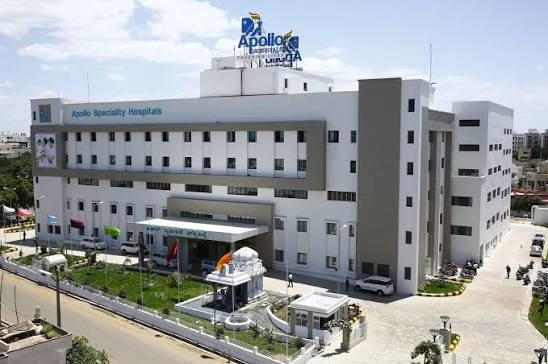
Apollo Hospitals provides perhaps the clearest illustration of both the opportunity and the challenge.
In its FY26 operating data, Apollo reported 3,420 operating beds across its non-metro cluster with 63% occupancy compared with 4,630 beds and 70% occupancy across its six metro markets.
There is an important qualification here: Apollo’s own “non-metro” category includes both Tier-1 and Tier-2 cities. It is therefore not accurate to describe the 63% figure as pure Tier-2/Tier-3 occupancy. The company includes cities such as Lucknow, Indore, Bhubaneswar, Guwahati, Madurai, Trichy, Nellore, Visakhapatnam, Kakinada, Mysuru, Nashik, Bilaspur and Rourkela in this broader non-metro grouping. That distinction matters. Nevertheless, the numbers demonstrate that Apollo has already built a substantial non-metro footprint while the occupancy gap with its metro hospitals indicates further room for maturation. The more interesting opportunity for Apollo is therefore not simply adding beds. It is improving utilisation and case mix at hospitals that already exist. A hospital moving from 60% to 70% occupancy can create considerably more operating leverage without requiring another large greenfield investment. That makes occupancy improvement an important part of the Tier-2 growth story.
Max Healthcare: Expansion but with a more selective approach
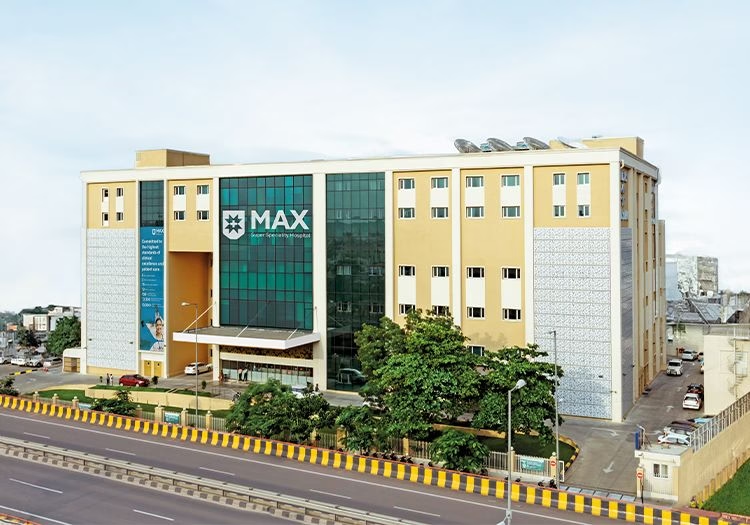
Max Healthcare’s strategy illustrates another aspect of the market. The company reported more than75% average occupancy across its network in Q1 FY27, despite a 13% year-on-year increase in operational bed capacity. Occupied bed days increased 10% year-on-year. But Max’s experience also shows why one should not assume that every new Tier-2 acquisition immediately performs like a mature Max hospital.
Its newly acquired Max Bhubaneswar, for example reported approximately 50% occupancy in Q1 FY27, with RPOB of ₹35,000. Management described both metrics as having significant room for improvement. This is perhaps one of the most useful numbers for understanding the economics of Tier-2 expansion.
Max management has described the typical hospital ramp-up as a sequence:
occupancy first → revenue growth → improvement in case mix and RPOB → profitability.
That is a more realistic picture of hospital expansion than simply counting newly added beds.Max is also expanding its presence across markets such as Lucknow, Nagpur, Mohali and Bhubaneswar while continuing substantial expansion within its established northern markets.
Yatharth offers a different picture of Tier-2 demand
Yatharth Hospitals provides perhaps the most interesting counterpoint.Its network is heavily concentrated in the Delhi-NCR and North India region including markets outside the traditional metropolitan healthcare centres.
In Q1 FY27, Yatharth reported approximately 75% occupancy across its existing hospitals. More strikingly, its Noida and Jhansi-Orchha hospitals recorded more than 90% occupancy, while Greater Noida was at 74% and Noida Extension at 56%.The Jhansi-Orchha performance is particularly relevant to the Tier-2 discussion.
But Yatharth’s numbers also contain an important warning.The newer hospitals in its portfolio are still ramping up. Greater Noida Extension, for example, was at 56% occupancy, while newer facilities in Greater Faridabad, New Delhi/Faridabad Sector 20 and Agra were still contributing to the group’s overall capacity expansion.
Why Are Hospital Chains Going to Tier-2 Cities?
India’s major hospital chains are increasingly expanding into Tier-2 cities because these markets offer growing demand for tertiary and specialised healthcare but relatively lower penetration of organised hospitals. Patients in cities such as Lucknow, Dehradun, Jhansi, Nagpur and Bhubaneswar often travel to metros for complex treatments such as cardiology, oncology, neurology and advanced surgery. By establishing regional hospitals closer to these patients, chains can capture demand that previously flowed to larger cities. Tier-2 markets also offer lower land and development costs, while expanding insurance coverage and rising healthcare awareness are supporting demand. However, the economics are different from metros: ARPOB is generally lower, so hospitals need stronger patient volumes and occupancy to achieve attractive returns. The real opportunity, therefore, is not simply to add beds, but to build regional healthcare hubs capable of serving patients across several surrounding districts.
The hidden constraint: doctors
There is another reason why the Tier-2 expansion story may take longer than the infrastructure story. Beds can be constructed relatively quickly. Specialist ecosystems cannot. A 300-bed hospital requires more than buildings and equipment. It needs consultants, surgeons, anaesthetists, intensivists, nurses, technicians, administrators and a referral network. The availability of high-quality specialists can therefore determine how quickly a hospital ramps up. This explains why established hospital chains have an advantage. A recognised brand can potentially attract doctors more easily, transfer clinical protocols and create referral networks faster than an independent new entrant. But even large chains cannot eliminate the specialist availability problem.
Greenfield versus acquisition: the next strategic battleground
The expansion model is also changing. Instead of building every hospital from scratch, large chains are increasingly combining:
greenfield projects + brownfield expansion + acquisitions + operating partnerships.
This is particularly relevant in Tier-2 markets because there are already several regional hospitals with established patient bases. For a national chain, acquiring such a hospital can provide three things immediately: a building, a doctor network and a patient catchment. The challenge then becomes upgrading infrastructure, introducing higher-end specialties, strengthening processes and improving occupancy.
Max Bhubaneswar is a useful current example of this model. Its 50% occupancy in Q1 FY27 illustrates the initial stage, management has indicated that the hospital has substantial headroom as infrastructure, clinical programmes and operating processes are strengthened.This is potentially a more capital-efficient way to enter regional markets than building every hospital from the ground up.
But is every Tier-2 city ready for a 300–500-bed hospital?
No. And this is where the current expansion cycle could become more selective. A city may have a large population but still lack the insurance penetration, specialist ecosystem or purchasing power required for a large premium hospital. The right question is therefore not: “Is this a Tier-2 city?” It is “Does thiscity have the catchment, disease burden, connectivity, paying capacity, referral ecosystem and specialist availability to support the proposed bed capacity?” That distinction will separate successful expansion projects from underutilised assets.
What happens to Tier-3 cities?
Tier-3 India is likely to require a different model. A 500-bed tertiary hospital may not be economically viable in every smaller city. Instead, the emerging model could be:
satellite clinic → diagnostics → specialist OPD → day-care → secondary hospital → regional tertiary hub.
In this model, the Tier-3 location becomes a feeder to the Tier-2 hospital. Digital consultations and specialist outreach can further connect these smaller markets to regional centres. This hub-and-spoke model could ultimately allow large chains to expand their catchment without replicating a full tertiary-care infrastructure in every city.
The biggest risk: too many beds chasing the same patient
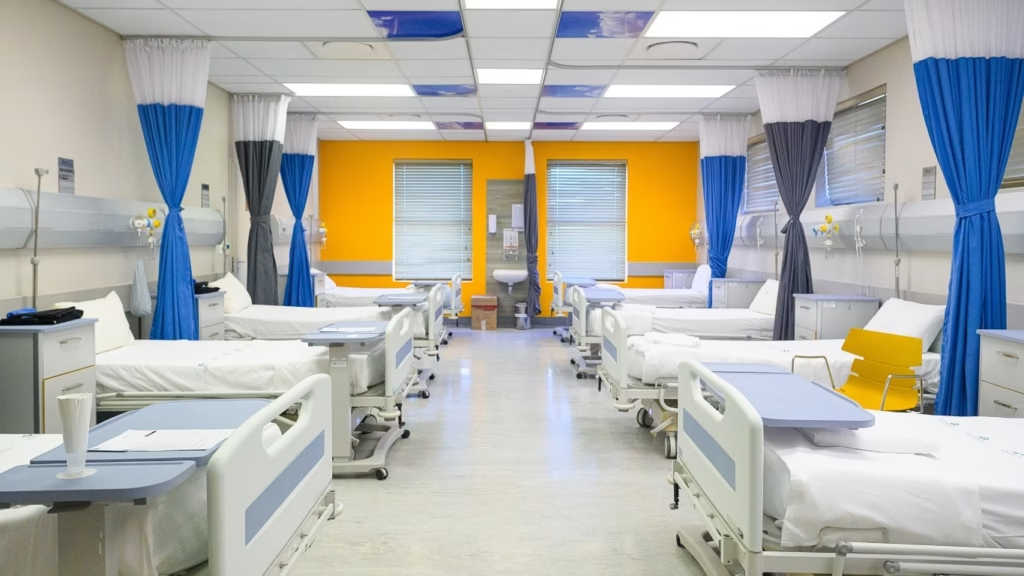
There is a paradox at the heart of India’s hospital expansion story. India still has a significant healthcare infrastructure deficit. But that does not mean every new hospital bed will automatically find demand. If several large chains enter the same Tier-2 market at approximately the same time, occupancy could take longer to mature. This is particularly relevant in cities that already have strong local hospitals. Competition could also put pressure on:
- consultant fees
- package prices
- insurance negotiations
- patient acquisition costs
- average revenue per occupied bed.
Therefore, the next phase of hospital expansion may produce winners and laggards within the same city. Brand alone will not guarantee occupancy. Clinical depth, doctor relationships, location, payer mix and reputation will matter.
The numbers to watch
For the next three to five years, the Tier-2 hospital story should be tracked through a much broader dashboard.
Occupancy
Is the hospital moving towards 65%, 70%, 75% and eventually 80%+?
ARPOB/RPOB
Is higher occupancy translating into better revenue, or is the hospital filling beds at lower realisations?
Mature versus new hospitals
How much of the company’s occupancy comes from established hospitals versus recently commissioned facilities?
Specialty mix
Are hospitals developing high-value specialties such as oncology, cardiac sciences, neurosciences and advanced surgery?
Payer mix
How much revenue comes from cash, private insurance and government schemes?
Doctor productivity
Are consultants generating sufficient patient volumes to support the hospital’s infrastructure?
ROCE
Ultimately, are the new beds producing acceptable returns on the capital invested? These metrics will tell us much more than the headline number of beds added.
KEY TAKEAWAY
The Tier-2 healthcare story is real but it should not be reduced to a simple “hospital giants are moving to smaller cities” narrative. The more significant development is that India’s healthcare catchments are expanding. Apollo’s non-metro network is already operating at scale although its occupancy remains below its metro portfolio. Max is using acquisitions and expansion to build regional presence but its Bhubaneswar experience demonstrates that new markets need time to mature. Yatharth, meanwhile, shows that a well-established regional hospital can achieve occupancy levels comparable with leading urban facilities.
The industry’s broader numbers reinforce the opportunity: ICRA expects continued revenue growth supported by new beds and occupancy ramp-up while CRISIL expects more than 10,000 beds to become operational over FY26-FY27. But the next phase will be less forgiving.
Building a hospital is a capital expenditure decision. Filling it is a market-development exercise. Making it profitable is a clinical and operational challenge.
That is why the real Tier-2 contest will not be decided by the company that announces the largest number of beds. India’s hospital map is therefore changing but the transformation will not happen uniformly. Some Tier-2 cities may emerge as the next Lucknow, Indore or Nagpur regional healthcare hubs capable of supporting multiple tertiary-care providers. Others may remain highly fragmented markets where smaller hospitals continue to dominate.
For hospital companies, the strategic question has consequently shifted from:
“Where can we build, fill, differentiate and earn sustainable returns?”
That is the real battle for India’s next generation of hospital beds.