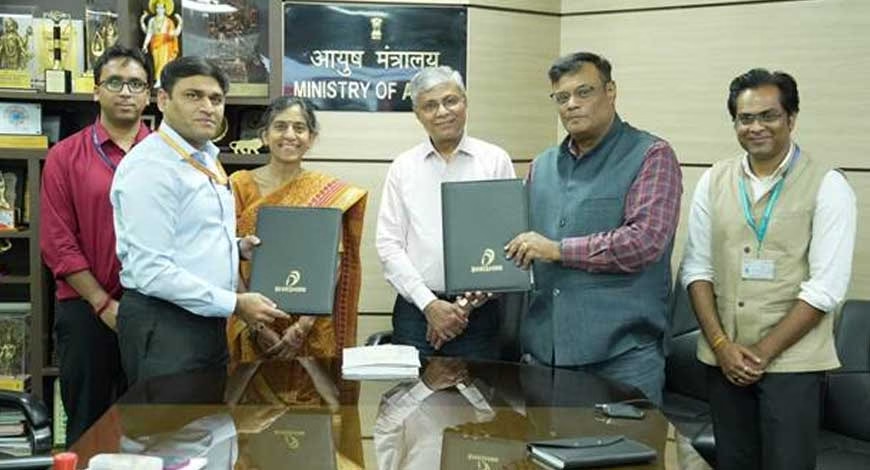
The Ministry of Ayush on May 15 signed a Memorandum of Understanding with the Digital India BHASHINI Division (DIBD) under the Ministry of Electronics and Information Technology (MeitY) to improve multilingual access to Ayush services and knowledge through AI-driven language technologies.
The agreement, signed under the initiative “BHASHINI Rajyam – A BHASHINI Sahayogi Programme,” aims to enable faster translation and transcription of Ayush-related content into multiple Indian languages using advanced artificial intelligence tools.
According to an official statement, the partnership will help integrate the BHASHINI platform India’s national language digital public infrastructure into various digital services and platforms managed by the Ministry of Ayush.
Through the Ayush Grid initiative, the ministry is already working in areas such as healthcare delivery, research, education, drug regulation, and capacity building. As part of the collaboration, several Ayush Grid portals, mobile applications, and AI-powered solutions are planned to be made available in all 22 languages listed in the Eighth Schedule of the Constitution, ensuring wider public access across the country.
The initiative will also focus on developing specialised multilingual terminology systems and strengthening language datasets related to Ayush systems including Ayurveda, Yoga and Naturopathy, Unani, Siddha, Sowa-Rigpa, and Homoeopathy. Context-aware AI models for healthcare and wellness communication are also expected to be developed.
The MoU was signed by Dr Subodh Kumar, Director, Ministry of Ayush, and Amitabh Nag, CEO of the Digital India BHASHINI Division.
Speaking on the occasion, Ayush Secretary Vaidya Rajesh Kotecha said that traditional Indian systems of medicine contain rich cultural and civilisational knowledge, and making this knowledge available in all Indian languages is important for inclusive healthcare delivery and public engagement.
He added that the collaboration with BHASHINI would strengthen multilingual capabilities within the Ayush ecosystem and support the development of future-ready AI systems capable of serving citizens across language barriers.
Dr Kavita Jain, Joint Secretary in the Ministry of Ayush, said the ministry has continuously worked towards using digital technologies to improve public access and service delivery. She described the collaboration as a significant step towards building a more inclusive and citizen-focused digital healthcare ecosystem.
Highlighting the importance of language-inclusive AI, Amitabh Nag said the partnership would help create multilingual and voice-enabled healthcare systems, ensuring that citizens can access digital services in their preferred languages while supporting India’s broader Digital Public Infrastructure mission.
Ayush Grid OSD Naman Goyal said that the Yoga Portal and the Ayush Grid master portal, MAISP, have already integrated BHASHINI plugins and received positive feedback from users accessing services in regional languages.
He added that after the signing of the MoU, all portals under the Ayush Grid ecosystem would gradually be integrated with BHASHINI to help Ayush services reach people across every region of the country without language limitations.
The discussions also explored the possible use of the NAMASTE Portal India’s digital repository of standardised Ayush terminology for glossary creation and future multilingual AI model development in the healthcare sector.