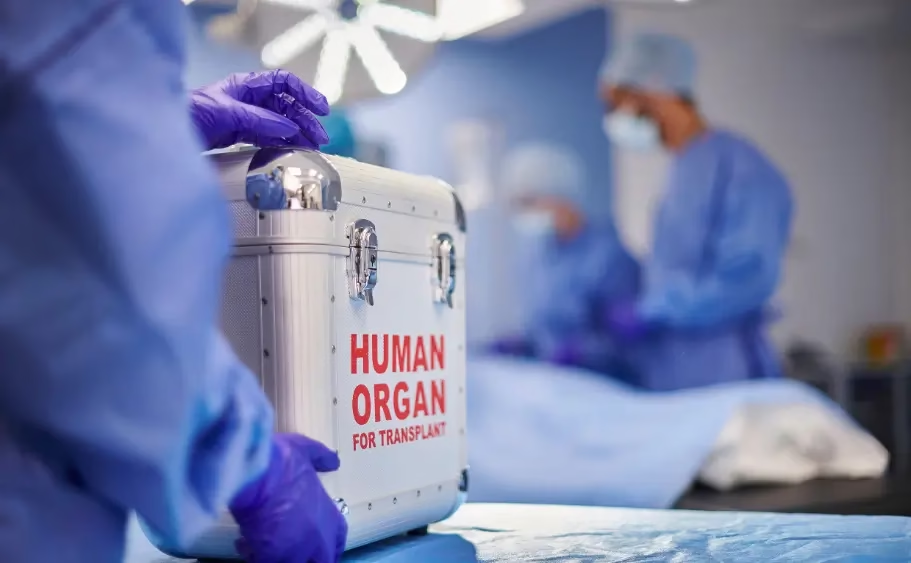
The Supreme Court has issued several directions to the Union government to create a national policy and uniform rules after consulting all States to ensure a transparent and efficient system for organ donation and transplantation.
A Bench of Chief Justice BR Gavai and Justice K Vinod Chandran passed the order while hearing a PIL filed by the Indian Society of Organ Transplantation.
The court asked the Centre to encourage Andhra Pradesh to implement the 2011 amendments to the Transplantation of Human Organs Act, 1994. It also instructed Karnataka, Tamil Nadu and Manipur to adopt the Transplantation of Human Organs and Tissues Rules, 2014 at the earliest, emphasising the significance of a harmonised framework.
The Bench further directed the Union government to develop a national policy that includes “model allocation criteria” for organ transplants. This policy must address caste- and gender-based disparities and lay down uniform donor criteria to eliminate inconsistencies across States.
Highlighting that States and Union Territories such as Manipur, Nagaland, Andaman and Nicobar Islands and Lakshadweep do not have a State Organ and Tissue Transplant Organisation (SOTO), the court asked the Centre to set up these bodies under the National Organ Transplantation Programme in consultation with the respective governments.
To protect live donors from exploitation, the court instructed the Centre to create guidelines ensuring their post-donation welfare and preventing any form of commercialisation.
Additionally, the Centre along with the National Organ and Tissue Transplant Organisation (NOTTO) was directed to amend birth and death registration forms (Forms 4 and 4A) to specify whether a death was due to brain stem failure and whether the family was given the option to donate organs.
Earlier, on November 18, the petitioner had highlighted the lack of uniformity in the application of the 2014 Rules, noting that some States, including Andhra Pradesh and Karnataka, continue to follow their own legislations. Senior advocate K. Parmeswar, representing the petitioner, also pointed out the absence of a unified national database of donors and recipients, the limited accessibility of transplants due to class and gender disparities, and the fact that nearly 90% of transplants occur in private hospitals.
Previously, on April 21, the court had asked the Centre to convene a meeting of chief secretaries and health secretaries of all States and Union Territories to collect detailed information on the adoption and implementation of transplant laws the 1994 Act, the 2011 amendment, and the 2014 rules as well as compliance with NOTTO guidelines. The data requested included the ratio of cadaver to live donations, gender disparities, awareness initiatives, financial support mechanisms, policies on swap transplants, allocation procedures, and the availability of hospitals capable of performing organ transplants. The consolidated report is to be submitted by July 18, 2025.