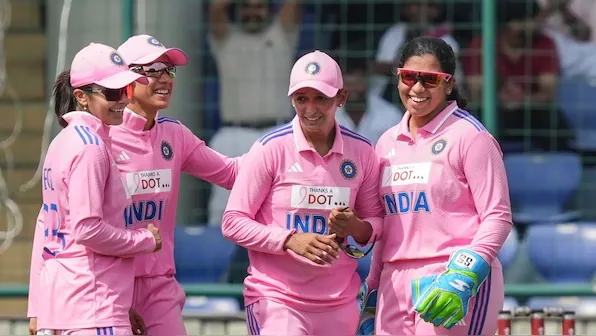
In a powerful display of sport for social change, SBI Life Insurance and the Board of Control for Cricket in India (BCCI) came together to spotlight breast cancer awareness through the Thanks-A-Dot initiative. The Indian Women’s Cricket Team took the field in pink jerseys featuring the Thanks-A-Dot logo during the ODI match against Australia, symbolising the importance of breast self-examination and early detection in saving lives.
Ahead of the match, a special jersey handover ceremony was held where SBI Life leaders and actress-cancer survivor Mahima Chaudhry presented the distinctive jerseys to Team India’s captain Harmanpreet Kaur and her teammates.
Speaking on the initiative, Mr. M. Anand, President & Chief Distribution Officer, SBI Life, said, “Thanks-A-Dot is our heartfelt effort to empower women with awareness and knowledge on breast health. With the Indian Women’s Cricket Team championing this cause on a global platform, we hope to inspire timely conversations and proactive self-care.”
Mahima Chaudhry added, “As a survivor, I know the value of early detection. The Thanks-A-Dot campaign and Hug of Life tool remind women to practice regular self-examination, which can truly save lives.”
Launched in 2019, Thanks-A-Dot has been educating and training women on self-examination and early detection. Its recent Hug of Life project creatively engraved 3D lumps on hot water bags commonly used by women to act as both a reminder and training aid for breast self-checks.
During the India-Australia ODI, the awareness drive reached fans directly:
- The dot ball counter was reimagined as the Hug of Life Bag, linking dot balls to distribution of Thanks-A-Dot kits for underprivileged women, supported by PRADHAN NGO.
- The pitch mat carried the TAD logo, keeping the message at the centre of the game.
By blending cricket’s mass appeal with a life-saving health message, SBI Life’s Thanks-A-Dot initiative reinforces the urgent need to normalise conversations about breast cancer, move past hesitation, and adopt proactive habits. The campaign stands as a reminder that early detection, awareness, and action can save lives and protect families.