
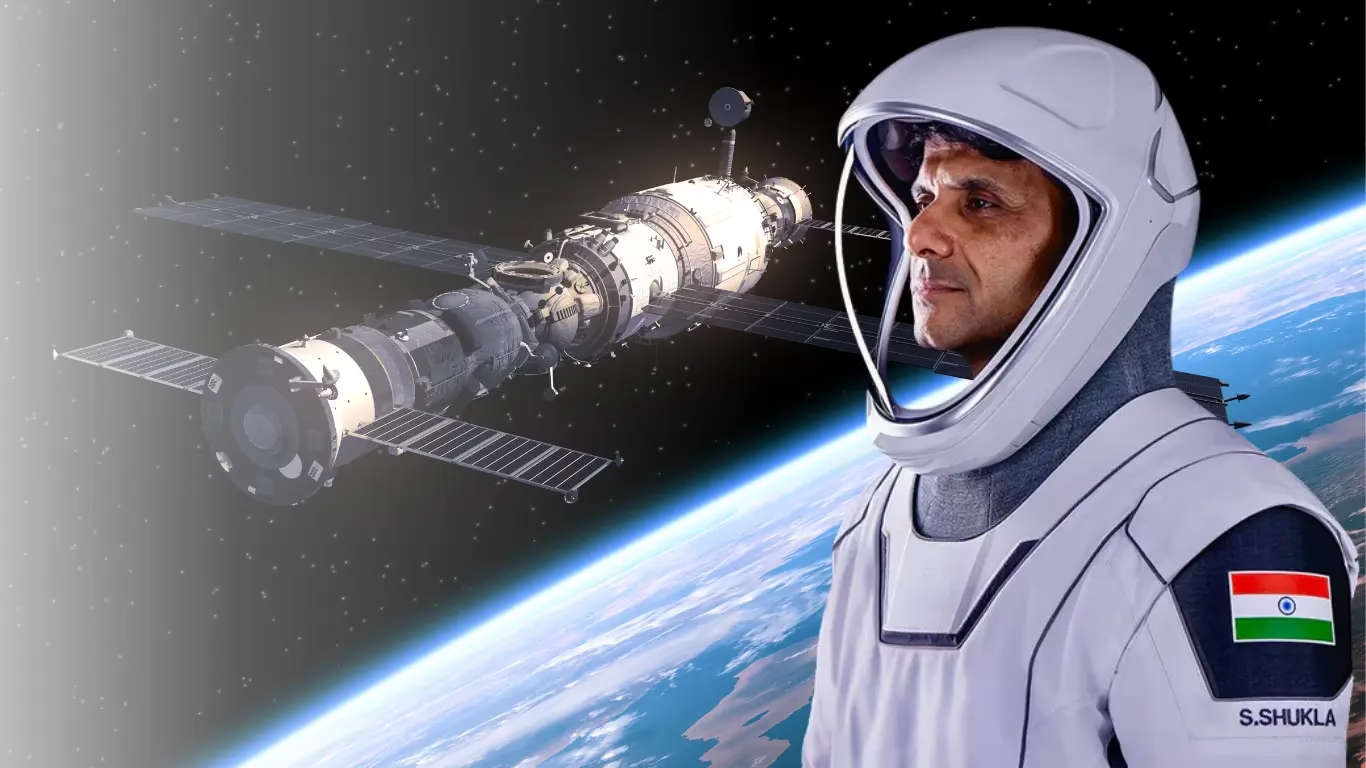
Indian astronaut Shubhanshu Shukla is set to etch his name in history books as he embarks on a groundbreaking journey aboard the Axiom-4 mission to the International Space Station (ISS). More than a personal milestone, Shukla’s mission represents a defining moment in India’s long-anticipated entry into human spaceflight, while also contributing to vital medical research that could reshape diabetes care both in space and on Earth.
Central to the Axiom-4 mission is a pathbreaking experiment to understand how glucose and insulin behave in space. Under the “Suite Ride” initiative a collaboration between UAE-based Burjeel Holdings and Axiom Space astronauts, including Shukla, will wear continuous glucose monitors (CGMs) during their 14-day stay aboard the ISS.
The study aims to observe how microgravity affects blood sugar levels. “We are trying just to see if there is any change or fluctuation to the blood-sugar levels while they are in space,” said Dr. Mohammad Fityan, Chief Medical Officer at Burjeel Holdings. Astronauts will also carry insulin pens stored at both room and refrigerated temperatures to study how insulin degrades or stabilizes in zero gravity.
Beyond observational data, the experiment may identify new pharmacological targets by tracking metabolic and hormonal changes. These insights could help develop treatments that improve insulin sensitivity or simulate exercise effects in sedentary individuals. Artificial intelligence models powered by this space data could also forecast insulin needs more accurately and enable personalized diabetes care, especially in remote or underserved areas via tele-health.
Notably, this study also challenges current limitations in space travel. NASA currently prohibits insulin-dependent diabetic astronauts from flying. Shukla’s mission could lead to policy changes that expand spaceflight access to those with insulin-dependent diabetes mellitus (IDDM), a group previously deemed unfit for such missions.
Shubhanshu Shukla’s radiant smile from the orbiting ISS isn’t just a moment of personal pride it marks India’s first real foray into the realm of human space exploration. While this isn’t an ISRO-led mission, its significance for India cannot be overstated. Shukla, one of four astronauts selected for India’s Gaganyaan human spaceflight programme, is laying the foundation for India’s independent crewed missions, with Gaganyaan’s first flight scheduled for 2027.
The Axiom-4 mission offered an unexpected yet invaluable opportunity. As India builds up to Gaganyaan, Shukla’s involvement in a private international mission gives ISRO firsthand exposure to crew operations, launch coordination, and in-orbit management. ISRO had a strong presence in the U.S. during the mission preparation, actively participating in launch operations a valuable learning experience that will directly inform India’s human space programme.
Globally, the space sector is undergoing a transformation. Private players are increasingly occupying low Earth orbit for commercial gains, while national agencies are shifting focus to more ambitious objectives the Moon, Mars, and beyond. The ISS, located in low Earth orbit, will soon be decommissioned, and countries are preparing for a new era of space research hubs.
India, too, plans to launch its own space station by 2035. While not yet part of the ISS consortium, India’s demonstrated capability and international collaborations make it a strong candidate for contributing to or co-developing future orbital platforms.
Shukla’s mission provides a critical stepping stone toward this future. As one of the astronauts trained in Russia and later at NASA, his experiences will prove vital in setting up India’s own astronaut training facility a long-overdue necessity that could also be opened to train astronauts from other countries, turning India into a global hub for space training.
Space has always been a domain of both competition and cooperation. Even historically adversarial nations like the U.S. and Russia have worked together on the ISS. India’s participation in international missions like Axiom-4, and its growing partnership with NASA, underscore the strategic importance of India’s space capabilities.
These collaborative efforts are not merely symbolic. They enable technology transfer, shared resources, and a wider pool of research data critical for developing next-generation solutions that benefit humanity as a whole.
Shubhanshu Shukla’s mission is not an end it’s a beginning. His journey to space is an embodiment of India’s growing prowess in space science, human health research, and international cooperation. It offers a preview of what lies ahead a future where Indian astronauts routinely travel to space, where Indian labs contribute to global science from orbit, and where India becomes a leader in the next phase of space exploration.
As Shukla orbits above Earth, his presence lights a path for the next generation of Indian scientists, engineers, and explorers proof that India’s space odyssey has truly begun.